Eivissa Sí › Ibiza Town › What to see
What to see in Ibiza Town
Dalt Vila and its walls, the Puig des Molins necropolis, the harbour and La Marina: a World Heritage city best explored on foot.

The neighbourhoods
Dalt Vila
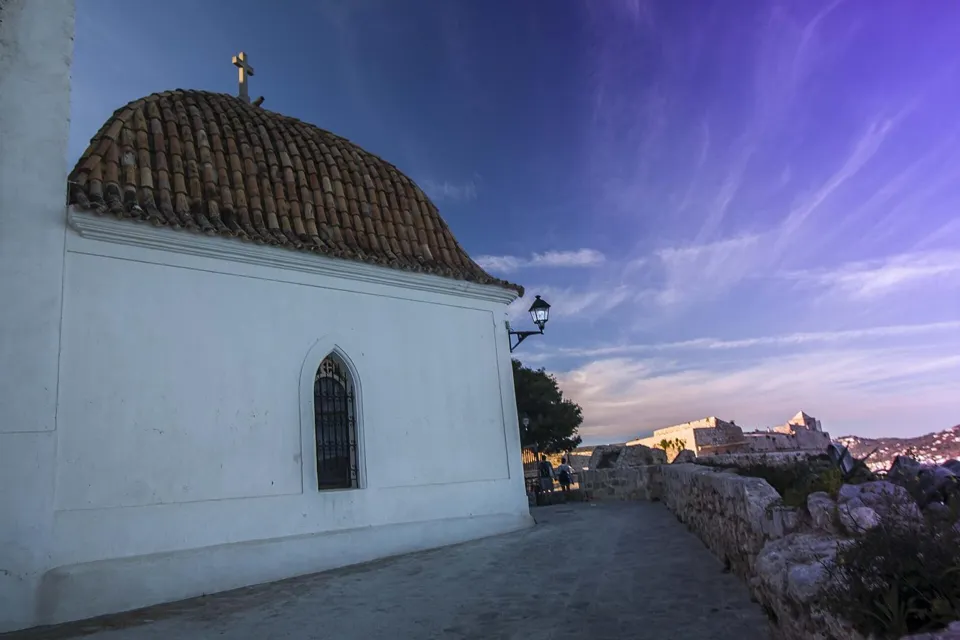
The upper town is the historic heart of Ibiza. The 16th-century Renaissance walls, with seven bastions, enclose a maze of cobbled streets climbing to Santa Maria de les Neus cathedral and the castle. Since 1999 it has been part of the UNESCO World Heritage site “Ibiza, Biodiversity and Culture”.
You walk in through the Portal de ses Taules, next to the Mercat Vell. Inside are the MACE, the Museu Puget, the Madina Yabisa interpretation centre, Plaça de Vila with its terraces and the Sant Jaume and Santa Llúcia bastions, the best viewpoints over the harbour and Formentera. In May it hosts the Medieval Fair.

La Marina and Sa Penya
Between the harbour and the walls lie the town’s seafaring quarters. La Marina grew up outside the walls as a district of traders and fishermen; today its narrow streets are full of shops, bars and restaurants, and at night it is one of the liveliest places in town.
Sa Penya, the point of white houses perched above the sea, keeps the layout of the old fishermen’s quarter. Below Dalt Vila stands the Mercat Vell, the neoclassical market of 1873, and on the quayside the Corsairs’ Obelisk. Boats to Formentera and Talamanca leave from here.

Eixample and Vara de Rey
The new town that grew from the late 19th century onwards is now the commercial and administrative centre. Its main axis is Vara de Rey, a tree-lined boulevard with the monument to General Joaquín Vara de Rey, an Ibizan who died in Cuba in 1898, and historic cafés such as the Montesol.
Around it are the shopping streets, banks and offices, the Mercat Nou, the food market where islanders buy local produce, and Avinguda d’Isidor Macabich. This is the everyday Ibiza of people who live here all year.

Ses Figueretes
One of the island’s first tourist districts in the 1950s and 60s, it is now mainly residential. Ten minutes’ walk from Vara de Rey, it has small sand-and-rock beaches between breakwaters and a promenade that runs on to Platja d’en Bossa.
The promenade is where locals walk, run or cycle by the sea, with views of Dalt Vila and Formentera, terraces and small shops. In summer it is family-friendly and out of season it keeps its neighbourhood life.

Talamanca
Across the harbour, Talamanca bay has a fine-sand beach almost a kilometre long with calm, shallow water, good for children, and a view of Dalt Vila you get from nowhere else. There is a promenade, restaurants and beachfront hotels.
You can walk from the harbour along the seafront and Marina Botafoc, take the town bus or, in summer, a boat from the quay. Behind the beach lie Ses Feixes, the old system of fields and channels dating from the Moorish period.

Es Viver and Can Misses
West of the centre, Es Viver and Can Misses are residential districts that have grown in recent decades. Here you will find Can Misses Hospital, the island’s main hospital, the Can Misses municipal stadium, secondary schools, health centres and sports facilities.
This is the practical side of town: supermarkets, local shops, parks and housing for people who live on the island all year. Es Viver reaches the sea at the southern end of Ses Figueretes, near Platja d’en Bossa.
Dalt Vila
Renaissance walls
Built in the 16th century to defend the city from Ottoman and pirate raids. Enter through the Portal de ses Taules and walk the bastions.
Santa Maria de les Neus cathedral
At the top of the hill, Gothic in origin with a Baroque makeover. Its square looks over the harbour, Formentera and the open sea.
Dalt Vila museums
The Contemporary Art Museum (MACE), the Museu Puget and the Madina Yabisa interpretation centre tell the story of the city and its art.
Below the walls
Puig des Molins
A Phoenician-Punic necropolis with thousands of tombs cut into the hill, a World Heritage site with its own museum.
La Marina and Sa Penya
Narrow streets of the old fishermen’s quarter, shops, terraces and the Mercat Vell, the neoclassical market facing Dalt Vila.
Vara de Rey
The tree-lined boulevard in the centre, with the monument to General Vara de Rey and historic cafés.
The harbour
Seafront
From the ferry quay to Botafoc, with views of Dalt Vila. At sunset it is where locals go for a stroll.
Corsairs’ Obelisk
A tribute to the Ibizan corsairs who defended the island in the 18th and 19th centuries.
Botafoc lighthouse
At the end of the breakwater, a flat walk with one of the best views of the walled city.
Photos: Foto elegida por Eivissa Sí