Eivissa Sí › History of the Pityusic Islands
History of the Pityusic Islands
From the first settlers to the island of tourism: nearly three thousand years at the heart of the western Mediterranean.


EIVISSA.SI · HISTORY OF THE WHOLE ISLAND
From the first settlers to the global island
60 chapters · More than 13,000 words · 60 different images · Updated: 26 October 2026
Ibiza did not begin with the hippies or the nightclubs. Before it became an image recognised all over the world, it was a land of small prehistoric communities, an outpost of Phoenician seafarers, a deeply Punic society, a Roman and Andalusi island, a frontier of the Crown of Aragon and a world of farmers, salt workers, fishermen and sailors. Its history has been shaped by the relationship between the port and the countryside, between openness to the outside world and the need to protect a small land, and between the continuity of its people and the arrival of newcomers.
This journey covers the whole island, not only the town of Ibiza. The names Ibiza and Eivissa refer here to the same territory; when the capital is meant, it is called the town, Vila or Dalt Vila. Formentera appears where it is essential to understand the shared history of the Pitiusas, without confusing what happened on each island. Dates for the oldest periods are approximate, and legendary traditions are identified as such.
Chronological contents
- 01 The island that rose from the seaMillions of years before history
- 02 The first inhabitants: an arrival before the PhoeniciansLate 3rd millennium BC
- 03 A prehistory of its own: caves, metals and small communities2nd millennium BC
- 04 Sa Caleta: the first great Phoenician laboratoryLate 8th and 7th century BC
- 05 Ibosim and the problem of the 654 BC date7th-6th centuries BC
- 06 Punic Ibiza: an island within Carthage’s networks6th-4th centuries BC
- 07 The Punic countryside: history also happened outside the townFrom the 5th century BC
- 08 Puig des Molins: a city of the dead beside the city of the living5th-2nd centuries BC
- 09 Tanit and es Culleram: a sanctuary in the north of the island5th-1st centuries BC
- 10 Bes on the coins: a protective image passed from hand to hand3rd-1st centuries BC
- 11 Ibiza in the Second Punic War: holding out and supplying a fleet217-205 BC
- 12 From the Carthaginian orbit to Roman rule2nd-1st centuries BC
- 13 Roman Ebusus: citizens, powerful families and coastal production1st-4th centuries AD
- 14 Christianity and the end of classical Antiquity4th-5th centuries
- 15 Vandals, bishops and a Mediterranean ruled from Africa5th-6th centuries
- 16 The Byzantine period and the centuries we know least6th-9th centuries
- 17 Yābisa: an island within al-AndalusFrom 902-903
- 18 Ses Feixes and water: farming where the town now grows10th-12th centuries
- 19 The Pisan-Catalan expedition: a conquest that did not last1114
- 20 The last Islamic Ibiza: walls, harbour and daily life12th century-1235
- 21 The Catalan conquest and the legend of the secret passage8 August 1235
- 22 The feudal share-out: new lands, new settlers and captive peopleFrom 1235
- 23 The Universitat: when governing the island did not mean having a university1299-1454
- 24 Salt: shared wealth, trade and hard work14th-15th centuries
- 25 The Renaissance walls: turning Ibiza into a modern fortressFrom 1555
- 26 Towers and signals: living with an eye on the sea16th-18th centuries
- 27 Fortified churches: to pray, to gather and to shelter16th-17th centuries
- 28 The farmhouse and a culture built to last17th-18th centuries
- 29 The Nueva Planta decrees and the end of the old island government1715-1724
- 30 Town, bishopric and new parishes to organise the land1782 and the following decades
- 31 Antoni Riquer and the sea fight that became island memory1 June 1806
- 32 Emigration: when seeking a future meant leaving19th century
- 33 Lighthouses and navigation: lighting a connected islandSecond half of the 19th century
- 34 The archduke who toured Ibiza on muleback1867
- 35 Archaeology uncovers another Ibiza beneath everyday Ibiza1903-1907
- 36 Walter Benjamin, Hausmann and the avant-garde travellers1932-1933
- 37 Hotels and the Tourism Board: the pre-war tourism project1933
- 38 The Civil War: landing, bombing and a lasting rift1936
- 39 The post-war years: surviving before the tourist boom1940s and early 1950s
- 40 Las Dalias before the markets: a village bar and a dance floor1954
- 41 The airport changes Ibiza’s scale1958 and the following years
- 42 Ibiza 59 and Broner: an island within the international avant-gardeFrom 1959
- 43 The tourist boom: a transformation lived from within1960s
- 44 The hippies: freedom sought, coexistence and contradictionsFrom the mid-1960s
- 45 The MACE and an island also told through art and film1969
- 46 Adlib: tradition becomes a new way of dressing1971
- 47 Pacha arrives in Ibiza and links the island with Sitges1973
- 48 Amnesia and the Balearic sound: a way of mixing the worldFrom 1976
- 49 Democracy, the Consell and the return of island self-governmentFrom 1979
- 50 Café del Mar: turning a sunset into musical cultureFrom 1980
- 51 Pikes and star-studded Ibiza: Wham!, Mercury and Caballé1983-1987
- 52 The markets: crafts, counterculture and economic activityFrom 1985
- 53 World Heritage: a history that also lies under water1999
- 54 Ses Salines: protecting a landscape worked for centuries2001
- 55 Ibiza and Formentera: two councils for a shared history2007
- 56 Hotels, big stages and the shift towards luxury experiencesFrom 2011
- 57 Posidonia and the ecological limits of prosperityFrom 2018
- 58 The pandemic: an interruption that revealed dependence on tourism2020
- 59 Recovery, housing and the right to keep living on the island2021-2026
- 60 Managing the flows and deciding the future: the Ibiza of our time2025-2026
01 · Millions of years before history
The island that rose from the sea

Author / credit: Joselodos. Wikimedia Commons: file page and original. CC0.

Long before anyone landed on its shores, the very stuff of Ibiza already had an extraordinary history. Much of its rock formed from sediments laid down in ancient marine environments, later folded, shifted and lifted by the tectonic movements linked to the formation of the Betic and Balearic ranges. Erosion gradually shaped that relief into the hills, platforms and cliffs we recognise today.
Es Vedrà and es Vedranell let us read this history on a large scale: geological studies describe a thrust there, a movement that placed older materials on top of younger ones. Its rugged look is not the cone of a volcano, however much the islet’s silhouette invites the idea. Nor do popular claims about exceptional magnetism replace a proven geological explanation.
This physical base would shape all later history. Limestone favoured the formation of caves and the underground flow of water; the spread of soils and slopes determined fields, terraces and paths; coastal inlets gave shelter to boats. The landscape that today seems designed for visitors was, for thousands of years, a set of opportunities and limits for living.
References: [1], [2]. Back to contents
02 · Late 3rd millennium BC
The first inhabitants: an arrival before the Phoenicians

Author / credit: Dreizung. Wikimedia Commons: file page and original. CC BY-SA 4.0.

The human history of Ibiza begins long before Ibosim. Archaeological research has documented prehistoric occupation at the turn of the 3rd to the 2nd millennium BC, although the exact moment of the first landing remains open to new excavations and dating. There is no founding date comparable to that of a city: settlement was a process, not a single known event.
One of the key sites is the puig de ses Torretes, near Cala Llonga. Its remains reveal communities that put up buildings, worked pottery and carried out productive activities. Reaching the island required seafaring knowledge and carrying the things needed to sustain a new life. Island life never meant a complete absence of contact, but a particular relationship with distance, supplies and risk.
For a long time the Phoenicians were credited as the first settlers because their remains were more visible and abundant. Archaeology changed that view. It is also wise not to illustrate this period with just any Balearic monument: the Ca na Costa tomb is on Formentera, and the great Talayotic complexes that usually accompany the islands’ prehistory belong mainly to Mallorca and Menorca.
References: [3]. Back to contents
03 · 2nd millennium BC
A prehistory of its own: caves, metals and small communities
Author / credit: A.Savin, Wikipedia. Wikimedia Commons: file page and original. FAL.

Ibiza’s Bronze Age societies are still less well known than those of the other islands in the archipelago. Settlement remains, cave finds and metal objects show real but fragmentary occupation. The absence of great monuments like those of Mallorca or Menorca does not mean an empty island: it means that forms of settlement, and their survival, were different.
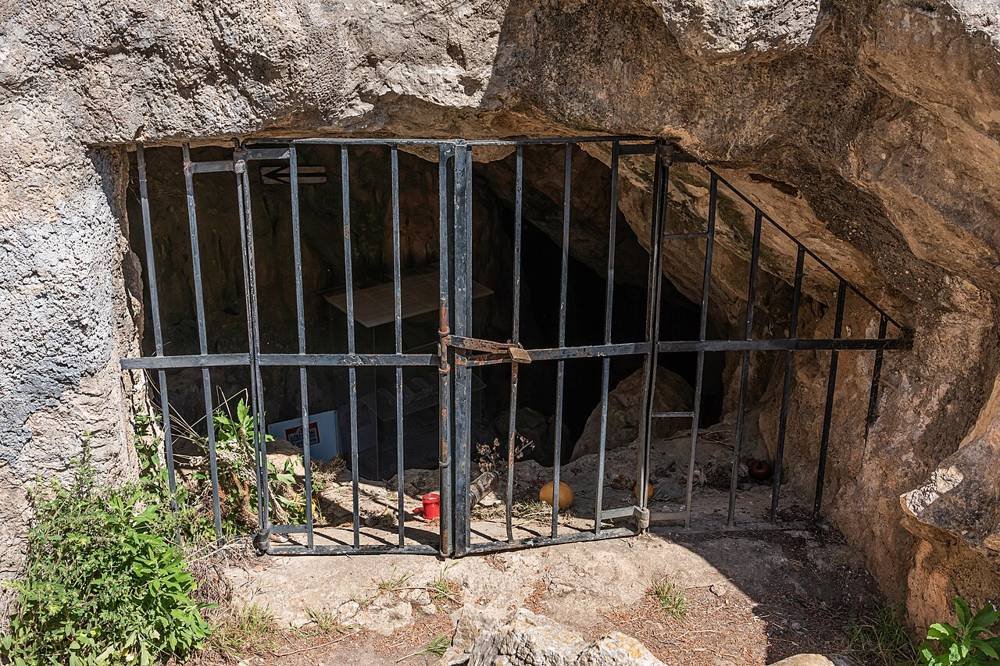
Caves such as es Culleram had a life before their fame as a Punic sanctuary. Objects from different periods force us to distinguish between visiting a cave, living in it, using it for productive work and turning it into a ritual space. The same caution should apply to Can Sergent and other sites whose interpretation depends on partial excavations and later reviews.
Metals bring another curiosity: a small island could take part in far-reaching exchange networks. The origin of the ore and the manufacturing techniques are studied through scientific analysis, not just from how objects look. At the puig de s’Argentera, the link with Phoenician mining is documented; earlier prehistoric mining has been suggested as a possibility, but should not be presented as certain. Ibiza’s oldest history is still written with questions.
References: [3], [4]. Back to contents
04 · Late 8th and 7th century BC
Sa Caleta: the first great Phoenician laboratory

Author / credit: Gerda Arendt. Wikimedia Commons: file page and original. CC0.

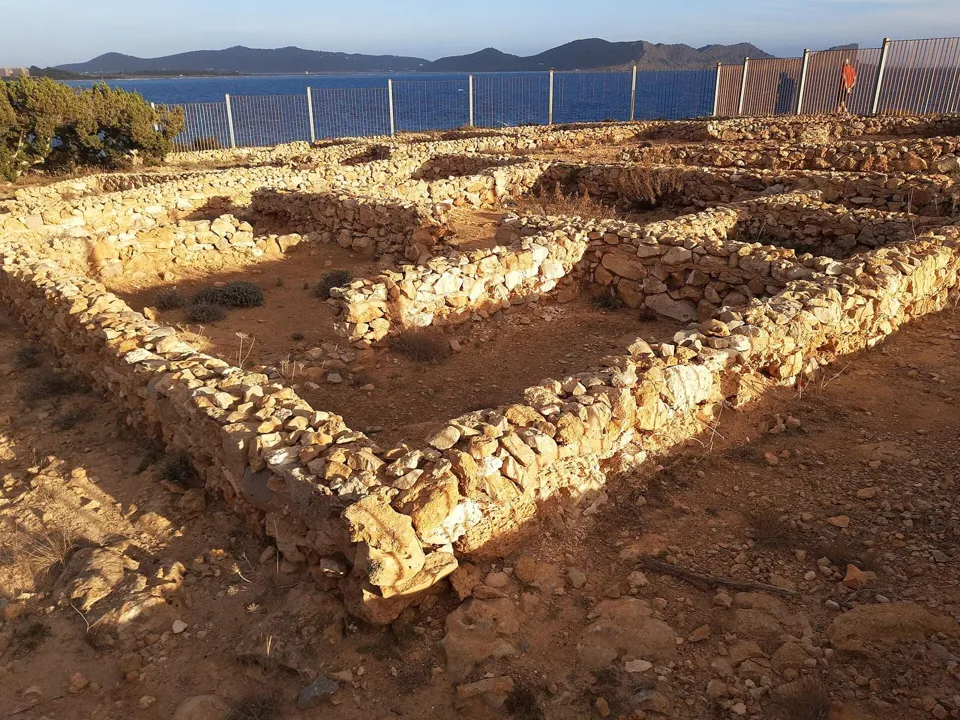
The settlement of sa Caleta marks a decisive change. On this small peninsula on the southern coast, a Phoenician community settled and connected the Pitiusas with networks of navigation, production and trade spread across the western Mediterranean. The clustered houses, passageways and work areas that survive offer a glimpse of daily life very different from the one suggested by images of great temples and palaces.
Metalworking played a prominent role. Among the activities identified is the processing of silver-bearing galena, along with work on other metals. The inhabitants also fished, gathered coastal resources and farmed. The economy did not depend on a single product: it combined what the island offered with the opportunities opened up by sea trade.
Around 600 BC the settlement was abandoned. Archaeologists describe an organised departure, with no need to imagine a violent destruction. The abandonment has been linked to the growth of the settlement on the bay of Ibiza, although the details of the move cannot be reconstructed as if we had a chronicle. That is precisely the great curiosity of sa Caleta: a community that left its site behind left an exceptional record of how a new island era began.
References: [5], [4]. Back to contents
05 · 7th-6th centuries BC
Ibosim and the problem of the 654 BC date

Author / credit: UnFUG-Fabi. Wikimedia Commons: file page and original. CC BY-SA 4.0.

The date 654 BC is often repeated as the birth of Ibiza. It comes from a literary tradition passed down by Diodorus Siculus, who linked the founding to that of Carthage. It is an important reference, but it is not a contemporary record and it does not automatically date every structure excavated in the town. The archaeology of sa Caleta and of the puig de Vila has enriched and refined that account.
The bay offered lasting advantages: shelter, access to resources and a hill from which to watch over the surroundings. On that landscape grew the urban core that, deeply transformed, has survived to this day. Close by, the burial ground of Puig des Molins took shape, a relationship between city and necropolis that is essential to understanding ancient Ibiza.
The popular explanation of the name Ibosim as «island of Bes» links the place name to a god shown on its coins, although the etymology has been debated and there are other proposals. Another confusion should also be avoided: the fact that Greek authors called these islands the Pitiusas, after their pine trees, does not by itself prove Greek colonisation. Names preserve memory, but they need interpreting.
References: [6], [7], [8]. Back to contents
06 · 6th-4th centuries BC
Punic Ibiza: an island within Carthage’s networks

Author / credit: Nanosanchez. Wikimedia Commons: file page and original. Public domain.

As Carthage’s influence grew in the western Mediterranean, Ibiza became part of a Punic cultural and economic world. This relationship should not be reduced to the image of a mere garrison dependent on a distant power. The island developed an urban society, remarkable craft production and a trading capacity that gave it a role of its own between North Africa, the Iberian Peninsula and the other Balearic Islands.
Pottery, transport jars and imported objects make it possible to trace these contacts. The tombs held pieces of many origins and traditions, including Greek pottery and Egyptian-style amulets. Their presence does not mean that each object arrived with a settler from where it was made: goods circulated, changed hands and took on new uses.
The most revealing curiosity is that Ibiza’s Punic identity was, from the start, a connected Mediterranean identity. Adopting foreign images, techniques and products did not erase local features. That combination of a strong island character and an intense relationship with the outside world would reappear, in completely different circumstances, at other moments in Ibiza’s history.
References: [9], [7]. Back to contents
07 · From the 5th century BC
The Punic countryside: history also happened outside the town

Author / credit: Paul Hermans. Wikimedia Commons: file page and original. CC BY-SA 3.0.

The prosperity of ancient Ibiza cannot be explained from the harbour alone. Rural settlement spread across the land and organised farming, the use of resources and movement between scattered sites. Beneath the landscapes we now associate with traditional estates and lanes lie much older layers of work and occupation.
Ses Païsses de Cala d’Hort is one of the most telling sites for understanding that long span. Its different phases show a rural site used for centuries, from the Punic period to later moments of the Roman and late antique world. The overlapping of dwellings, installations and burial areas makes it impossible to attribute everything visible to a single generation.
Farming linked everyday subsistence to the maritime economy: goods had to be produced, stored and transported before being shipped. Amphorae were a key technology in that chain. Today a broken jar can provide information on production, routes and dating that was never written down in any document. When touring the south-west, it is worth remembering that the drama of es Vedrà coexisted for centuries with less showy but essential tasks: growing crops, tending animals, mending tools and securing the next harvest.
References: [5]. Back to contents
08 · 5th-2nd centuries BC
Puig des Molins: a city of the dead beside the city of the living

Author / credit: Nanosanchez. Wikimedia Commons: file page and original. Public domain.

The Puig des Molins necropolis is one of the most important sources for understanding Ibiza’s Phoenician-Punic society. It was first used in the Phoenician period and remained in use throughout Antiquity. The thousands of burials recorded do not belong to a single moment: they reflect a long history of rites, reuse and changing ways of relating to death.
The hypogea, rock-cut chambers reached down a shaft, are its most characteristic image. They contained grave goods, jewellery, vessels, amulets and other objects that shed light on social differences, trade and beliefs. Not everyone was buried in the same way or with the same goods, and uneven preservation calls for caution when reconstructing their lives.
One of its most delicate curiosities is the decorated ostrich eggshells. They reached the island through trade networks and are associated with ideas of life and rebirth; their fragility makes excavating and restoring them an extraordinary task. The name Puig des Molins, on the other hand, is medieval: it comes from the windmills that crowned the hill many centuries after it first became a cemetery.
References: [6], [10]. Back to contents
09 · 5th-1st centuries BC
Tanit and es Culleram: a sanctuary in the north of the island

Author / credit: A.Savin, Wikipedia. Wikimedia Commons: file page and original. FAL.

On the wooded slope above the Cala de Sant Vicent area, the es Culleram cave preserves the memory of a Punic sanctuary linked to Tanit. Its location is a reminder that religious life was not confined to the town: the countryside also had places of pilgrimage, offering and gathering.
Excavations recovered many terracottas, including female figures with bell-shaped bodies and elaborate headdresses, as well as other ritual material. Inscriptions record dedications and names that bring religious practice closer to real people. The value of the site lies not only in the beauty of its objects but in the chance to study how a community expressed gratitude, fears and hopes.
Over time Tanit became one of the modern symbols of Ibiza, but that popularity has simplified her story. Not every Punic female figure necessarily represents the same goddess, and some pieces traditionally called «Tanit» follow models of other deities, such as Demeter. Nor do the modern altars and offerings that may be seen in a cave prove unbroken continuity since Antiquity. The sanctuary’s present-day memory is a different story from its ancient use, though both are fascinating.
References: [11]. Back to contents
10 · 3rd-1st centuries BC
Bes on the coins: a protective image passed from hand to hand

Author / credit: Bibliothèque nationale de France (reproduction; photographer not identified in the record). Wikimedia Commons: file page and original. Public domain.

Coins offer an especially direct way into Punic Ibiza. The issues of Ebusus spread the figure of Bes, a protective god of unusual appearance, linked in the Mediterranean world to the defence of home and life. His image, so different from the ideal of beauty in many classical sculptures, is easy to recognise and helped build a distinctive visual identity.
A coin was not just something to pay with. It also conveyed authority, belonging and trust within a trading network. Studying coins reveals changes in inscriptions, images and weights, as well as links between the island and other markets. Minting and circulation kept changing as the island joined the Roman world.
The association between Bes and Ibiza’s ancient name is one of its best-known curiosities, but it is worth keeping the difference between an etymological interpretation and direct proof. Something similar happens with ancient accounts of the absence of venomous animals and the protective virtues of Ibizan soil: they are interesting evidence of what was believed or said about the island, not descriptions that can simply be applied to its present-day wildlife.
References: [12], [8]. Back to contents
11 · 217-205 BC
Ibiza in the Second Punic War: holding out and supplying a fleet

Author / credit: Classical Numismatic Group, Inc. http://www.cngcoins.com. Wikimedia Commons: file page and original. CC BY-SA 3.0.

The war between Rome and Carthage reached Ibiza’s waters. In 217 BC a Roman expedition attacked the island but failed to take its fortified core. The resistance shows the strategic value of the site and is a reminder that trade routes could quickly become military corridors. The harbours that brought prosperity also attracted danger.
In 205 BC, according to Livy, Mago, Hannibal’s brother, found a favourable welcome in Ibiza and obtained supplies, weapons and men to continue his campaign. The episode suggests the logistical importance of a community able to supply ships, without turning all its inhabitants into soldiers. Behind a fleet stood farmers, craftsmen, storekeepers and supply networks.
The link with Hannibal has fed a persistent legend: that the general was born in Ibiza, often on a particular islet. There is no accepted historical evidence to state this as fact. The island’s documented connection with the Carthaginian world is important enough without that legendary birth. Separating the two enriches the story: it keeps the curiosity while avoiding building a biography on an unproven tradition.
References: [9], [7]. Back to contents
12 · 2nd-1st centuries BC
From the Carthaginian orbit to Roman rule
Author / credit: Joan Gené. Wikimedia Commons: file page and original. CC BY-SA 4.0.

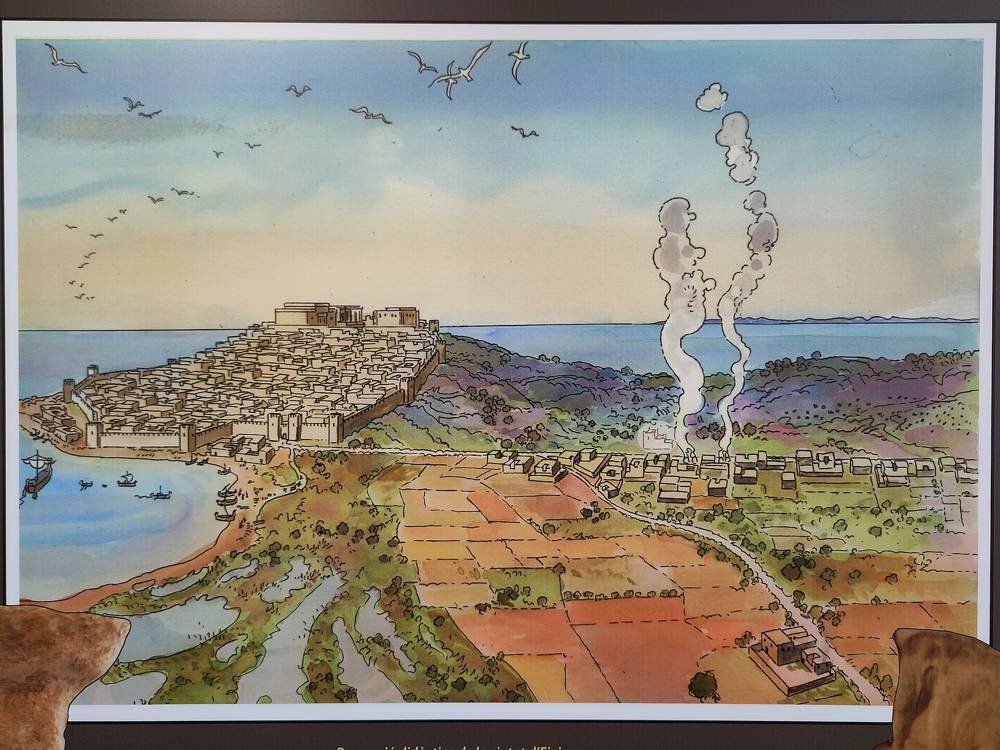
After Carthage’s defeat, Ibiza was gradually absorbed into the Roman system of power. The transition did not mean the instant disappearance of its people or their cultural practices. The persistence of Punic features in materials, names and coin images reveals a long adaptation, in which loyalties and institutions changed at different speeds.
Pliny the Elder described Ebusus as a federate city. The exact timing and circumstances of its agreement with Rome have been debated by scholars, so it is unwise to turn a hypothesis into an undisputed date. A legal relationship with the dominant power could offer some room for autonomy, but always within an obvious imbalance of power.
The continuity of trade and rural activity helps explain why Romanisation was more than a change of flag. New forms of authority and trade were layered over a society with roots of its own. A Punic-looking piece found in a Roman context is not a contradiction: it is a sign of how cultures survive and change. Ibiza entered the Roman world carrying a good part of its past with it.
References: [13], [7]. Back to contents
13 · 1st-4th centuries AD
Roman Ebusus: citizens, powerful families and coastal production

Author / credit: Sobrassada. Wikimedia Commons: file page and original. CC BY 3.0.

In imperial times Ebusus acquired the institutions and forms of representation of a Roman city. Its status as a Flavian municipium is usually linked to Vespasian’s grant of Latin rights around AD 73-74. Inscriptions show prominent families and acts of public benefaction, a way of studying local power beyond the great emperors.
Economic life combined the countryside, workshops and the sea. On the Santa Eulària coast, the remains of s’Argamassa recall the importance of water and production installations. Not every aqueduct should be imagined as a monumental row of great arches: a modest channel could be decisive for running an economic activity.
In grave goods, oil lamps, vessels and jewellery reveal changes in consumption and beliefs. The island belonged to a wide Roman world without becoming an exact copy of Rome. It is also important to remember the gap between its social classes: the inscription that preserved the name of an influential figure does not record the experience of all the workers who kept the city going. Ibiza’s Roman history is reconstructed as much from those surviving words as from everyday objects that nobody thought of turning into monuments.
References: [13]. Back to contents
14 · 4th-5th centuries
Christianity and the end of classical Antiquity

Author / credit: JanManu. Wikimedia Commons: file page and original. CC BY-SA 3.0.

The spread of Christianity gradually changed forms of worship, the organisation of communities and the burial places of Ibiza. Records of its first bishops and archaeological remains show that the island took part in the religious networks of the western Mediterranean. It was not an instant transformation, nor can it be assumed that old practices all disappeared at once.
The cave of Santa Agnès, near Sant Antoni, is one of the places linked to this early Christian memory. Its interpretation and its different phases call for caution: a later religious tradition cannot by itself date every visible part of a site. That is precisely why collaboration between archaeology, the study of materials and written records is so valuable.
During these centuries the political and economic framework of the Roman Empire also changed. However, speaking of the «fall of Rome» should not suggest that all life on the island switched off one day. Sea links and rural activities continued, albeit under new conditions. The contrast between the scarcity of texts and the persistence of everyday objects points to a basic limitation: we know far less about some periods than others, but documentary silence does not mean an absence of people.
References: [14]. Back to contents
15 · 5th-6th centuries
Vandals, bishops and a Mediterranean ruled from Africa

Author / credit: Joan Gené. Wikimedia Commons: file page and original. CC0.

In the 5th century the Balearics passed into the sphere of the Vandal kingdom based in North Africa. For Ibiza, the change did not mean entering a disconnected world, but being tied to a power that controlled lands and routes across the sea. The geography of Mediterranean relations still mattered more than the borders we now take for granted.
The record of Bishop Opilio, linked to councils called within the Vandal realm, shows that an organised Christian community existed. Religious tensions between the Arian rulers and the Catholic bishops were part of wider conflicts, although we have no detailed account of how they affected each Ibizan family.
Another curiosity of the island’s church history comes with Bishop Vincent and his correspondence with Licinianus of Cartagena, already on the threshold of the next period. The debate over a letter supposedly sent from heaven offers a glimpse of a world in which pious messages, doubts and warnings against credulity circulated. Even in an age we often call «dark», people argued about how to tell legitimate authority from forgery. The island was not outside those intellectual and religious debates.
References: [14], [15]. Back to contents
16 · 6th-9th centuries
The Byzantine period and the centuries we know least

Author / credit: Paul Hermans. Wikimedia Commons: file page and original. CC BY-SA 3.0.

The conquest of the Vandal kingdom by Justinian’s armies brought the Balearics into the Eastern Roman Empire during the 6th century. From our point of view, calling Ibiza «Byzantine» may seem surprising; for the people of the time it meant remaining within a Roman imperial tradition whose political centre lay much further east.
Links with North Africa and other Mediterranean lands remained essential. Pottery and burial sites make it possible to trace activities and relationships that texts barely describe. Rural settlement did not disappear, although its size, organisation and changes cannot be reconstructed with the precision available for other periods.
Between the weakening of imperial control and the consolidation of Islamic rule lies an especially difficult stretch. Raids, contacts and possible agreements with outside powers should not be mistaken for a permanent administration proven for every year. That is why it is misleading to present a list of conquerors in which each people neatly replaced the one before. Uncertainty is part of historical knowledge: acknowledging it helps explain why a modest excavation or a new date can change what we know about several centuries of the island’s past.
References: [7], [5]. Back to contents
17 · From 902-903
Yābisa: an island within al-Andalus
Author / credit: Michela Simoncini from Firenze, Italy. Wikimedia Commons: file page and original. CC BY 2.0.

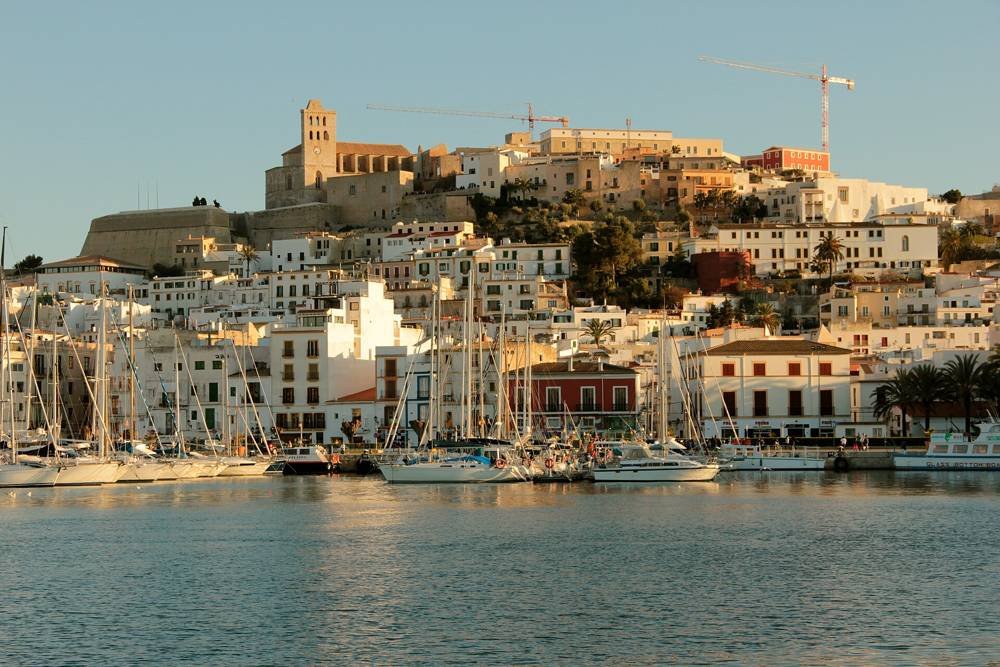
In the early 10th century the Balearics were brought under the Umayyad power of Córdoba. In Ibiza an Andalusi period began that transformed settlement, social relations and the organisation of the land. Research places within this process the arrival of North African groups, especially Amazigh (Berber), alongside other elements of the Islamic world. It was not just a change of name for the capital.
The town, known as Madina Yābisa, was organised around the walled hilltop and its relationship with the harbour and farmland. After the break-up of the caliphate, the island was tied to the taifa of Dénia and to the shifting political structures of the western Mediterranean. The sea connected it both to the Iberian Peninsula and to the Maghreb.
Place names preserved in the landscape and the archaeology of settlements allow this legacy to be studied, but not every old-sounding word or whitewashed house should automatically be attributed to the Muslims. An important curiosity is that the history of that population keeps surfacing beneath the modern town: excavations of its cemeteries are providing information on diet, mobility, kinship and diversity. Islamic Ibiza was a society of real people, not just an interval between Rome and the conquest of 1235.
References: [16], [17], [20]. Back to contents
18 · 10th-12th centuries
Ses Feixes and water: farming where the town now grows

Author / credit: JanManu. Wikimedia Commons: file page and original. CC BY-SA 3.0.

Andalusi Ibiza left a particularly striking mark on its water systems. Near the bay, ses Feixes turned wetland into a carefully organised farming landscape. Channels, plots and access points combined drainage and cultivation, creating a productive area linked to feeding the town.
That landscape was not untouched nature. It was a human construction that needed knowledge, maintenance and agreements on the use of water. Understanding this changes how we look at rural history: a seemingly simple plot can hold complex technology and a form of social organisation. Water was not only for drinking; it decided what could be grown, where and how reliably.
The traditional gateways of ses Feixes became one of its most recognisable images, although the visible structures may date from later alterations. The continuity of a farming area does not mean all its features are equally old. With urban and tourist growth, these market gardens came under new pressures. Today their conservation combines historical and environmental values: preserving ses Feixes means remembering that part of the capital’s immediate landscape was, for centuries, food infrastructure before it became coveted building land.
References: [17], [18]. Back to contents
19 · 1114
The Pisan-Catalan expedition: a conquest that did not last

Author / credit: Anonymous (medieval work); University Library of Pisa (source of the reproduction). Wikimedia Commons: file page and original. Public domain.

In 1114 an expedition led by Pisa, with Catalan and other participation, attacked Ibiza as part of a wider campaign against the Balearics. The context mixed commercial interests, the struggle for control of the sea, captives and religious justifications. The island was part of a Mediterranean frontier where raids and the taking of captives affected communities of different faiths.
The town was taken, but the expedition did not establish a lasting Christian occupation. This detail is essential so as not to confuse the episode with the conquest of 1235. After the attackers withdrew, the island remained within the Islamic world and went through new political reorganisations.
One of the main sources is the Liber Maiolichinus, a Latin poem celebrating the campaign from the Pisan point of view. Its historical value is enormous, but so is the need to read it as a partisan account rather than a neutral camera. Among its curiosities is an early use of terms related to «Catalans» and «Catalonia». So an attack suffered by Ibiza became tied to an important document in the history of medieval political identities. The memory of an event can be preserved far from where it happened.
References: [19]. Back to contents
20 · 12th century-1235
The last Islamic Ibiza: walls, harbour and daily life

Author / credit: Charles from Port Chester, New York. Wikimedia Commons: file page and original. CC BY 2.0.

During the 12th century and the first decades of the 13th, Ibiza remained tied to the changes in Islamic power in the Balearics. The fortifications of Madina Yābisa, its gates and its relationship with the harbour reflected a setting of trade and threat. The town cannot be understood apart from its countryside: it needed food, water, materials and people moving between the two.
Medieval structures preserved beneath later buildings and remains of the wall help reconstruct that layout. The Madina Yabisa interpretation centre reveals part of that legacy, often less visible than the Renaissance fortifications that now dominate the image of Dalt Vila. Today’s town holds buildings layered on top of others, not a series of intact districts for each civilisation.
There were also mining and production activities outside the capital. Research at the puig de s’Argentera has identified a medieval Islamic mine, a reality that broadens the usual picture of market gardens and seafaring. Its study distinguishes techniques and phases through pottery, tool marks and dating. On the eve of 1235, the island had a settled society and a worked landscape: the conquest would profoundly change that reality and the lives of its people.
References: [20], [4]. Back to contents
21 · 8 August 1235
The Catalan conquest and the legend of the secret passage

Author / credit: Charles from Port Chester, New York. Wikimedia Commons: file page and original. CC BY 2.0.

The capture of Ibiza on 8 August 1235 was organised by Guillem de Montgrí, with Nunó Sanç and Prince Peter of Portugal, as part of the expansion of the Crown of Aragon. James I authorised the venture, but he should not be presented as the king who personally led the assault on the town.
The conquest changed the power structure, land ownership, religious organisation and linguistic development of the island. For the Muslim population it meant defeat and rupture; for the new lords and settlers, the opening of a territory to be reorganised according to their interests. The date became part of Ibiza’s festive calendar and public memory.
The chapel of Sant Ciriac preserves one of the best-known legends: a quarrel within the Muslim ruler’s family supposedly led to a secret entrance being revealed to the attackers. The story dramatically explains a military victory and is linked to the small passage shown at the site. It should be told as tradition, not as a method of conquest proven by the records. Its interest also lies in seeing how a community turns a violent episode into shared memory, a town walk and an annual celebration.
References: [14], [21]. Back to contents
22 · From 1235
The feudal share-out: new lands, new settlers and captive people

Author / credit: Chixoy. Wikimedia Commons: file page and original. CC BY-SA 4.0.

After the conquest came the share-out. The countryside was organised into quartons (districts) and rights were distributed among those who took part in the venture. The new property structures and feudal obligations determined who could work the land, to whom rents were owed and what position each person held in society. The arrival of Catalan settlers permanently transformed the island’s language and institutions.
The other side of this process was the fate of the defeated. Enslavement, captivity, ransoms and limited chances of staying or leaving are an essential part of Ibiza’s medieval history. It is not accurate to describe the conquest as a peaceful cultural replacement, nor, conversely, to imagine the same path for all Muslims.
The land kept earlier names and uses while its owners and social framework changed. This mix of material continuity and political rupture explains why a landscape can keep an irrigation channel or a place name and yet belong to a very different society. The curious thing about the quartons is that their memory survived later administrative divisions: medieval organisation left a territorial vocabulary that still helps interpret Ibiza’s historical geography.
References: [22]. Back to contents
23 · 1299-1454
The Universitat: when governing the island did not mean having a university

Author / credit: Font i Torner. Wikimedia Commons: file page and original. Public domain.

The word Universitat can mislead today’s visitor. In medieval Ibiza it meant the community and its governing institution, not a place of higher education. Its organisation was regulated in 1299 and for centuries it handled the representation and management of Ibiza and Formentera, based in the town.
The institution reflected an unequal society. The so-called mans (hands) grouped people of different standing: the elite, urban trades and the rural population. Its bodies dealt with matters of common interest, but representation did not mean universal suffrage or modern democracy. Tensions between town and countryside, and between groups with different economic power, were part of how it worked.
In 1454 an election system known as sac i sort was introduced, based on drawing names from a bag. A small child drawing the lots is one of the most striking anecdotes preserved in accounts of the institution. Chance operated within a pre-set list of eligible people: not everyone could go into the bag. The curiosity shows how past societies tried to regulate access to power with mechanisms that may seem strange today but had their own political logic.
References: [23]. Back to contents
24 · 14th-15th centuries
Salt: shared wealth, trade and hard work

Author / credit: Chixoy. Wikimedia Commons: file page and original. CC BY-SA 4.0.

For centuries salt was one of Ibiza’s great strategic resources. Before modern refrigeration, preserving food depended largely on techniques in which salt was essential. The salt pans therefore linked local work with steady outside demand and turned part of the southern landscape into economic infrastructure.
The Universitat played a central role in managing them in the Middle Ages, within a web of rights and obligations. The wealth generated by exports did not remove the toil of those who worked the pans, gathered the salt and loaded it for shipping. The phrase «white gold» may sum up its value, but it also softens a reality of physically demanding days and dependence on the weather.
Today’s salt-pan landscape is the result of successive changes, not an installation frozen since Antiquity. Its channels, basins and loading systems reflect different needs and technologies. That long continuity explains an important curiosity: an industrial activity can also create a space of enormous ecological value. The pans built and maintained to produce salt also became a refuge for birds and part of an internationally recognised natural heritage.
References: [24], [5]. Back to contents
25 · From 1555
The Renaissance walls: turning Ibiza into a modern fortress
Author / credit: Xaviduran. Wikimedia Commons: file page and original. CC BY-SA 3.0 es.

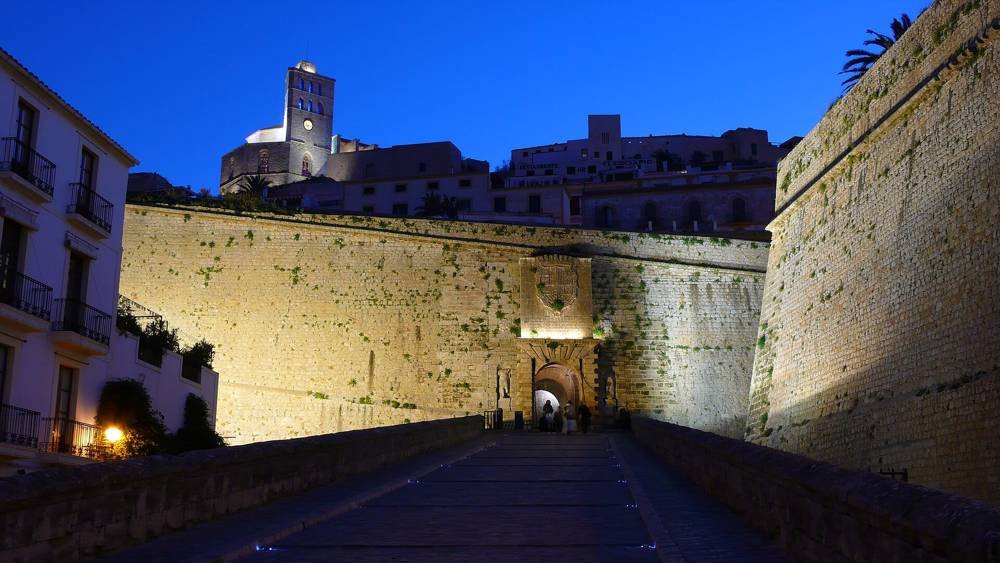
The spread of artillery made many medieval defences inadequate. In the 16th century the monarchy launched a major overhaul of Ibiza’s fortifications, begun under Giovanni Battista Calvi and later modified by Giovan Giacomo Paleari, known as il Fratino. The circuit that defines Dalt Vila today belongs to that world of engineers, cannons and geometric defence.
The bastions covered different angles and made it hard for an enemy to approach without coming under fire. Their position, thickness and relation to the terrain followed a complex military logic. The work required money, materials and labour, and disrupted town life. It was not simply a taller wall round the same town, but a reorganisation of its defence.
The Portal de ses Taules preserves the monumental image of that power. Its name recalls the planks used in the entrance passage, and the ancient statues built into it show another way of reusing the past. The Renaissance fortress later became heritage and a place to stroll, but its spaces were built to withstand a siege. Its views mean more once you understand that every beautiful angle was also a calculation of distances, trajectories and weak points.
References: [21], [53]. Back to contents
26 · 16th-18th centuries
Towers and signals: living with an eye on the sea

Author / credit: Enrique Ayesta Perojo. Wikimedia Commons: file page and original. CC BY-SA 4.0.

Corsair raids and the risk of capture shaped Ibizan life for a long time. The coast was a gateway for trade but also a line of exposure. Watchtowers, refuges and warning systems made it possible to spot ships and pass on news to a population that did not live in a single defended centre.
Not all the towers belong to the same period or had exactly the same function. Some protected rural homesteads; others watched over strategic points on the coast. Their architecture, raised entrances and interior layout met practical needs. Signals had to turn a distant sighting into useful time to take shelter, gather defenders or protect goods and people.
The Torre de ses Portes, between ses Salines and es Cavallet, recalls the strategic value of the sea passage to Formentera. In the north, places like Balàfia show how defence became part of domestic life. It is worth distinguishing piracy from privateering: the latter was carried out with the authorisation of a ruler and was no less violent for those who suffered it. Ibiza was the victim of attacks, but it also had its own privateers. The history of the sea does not allow the roles of aggressor and victim to be permanently assigned to whole peoples.
References: [25], [26]. Back to contents
27 · 16th-17th centuries
Fortified churches: to pray, to gather and to shelter
Author / credit: A.Savin, Wikipedia. Wikimedia Commons: file page and original. FAL.

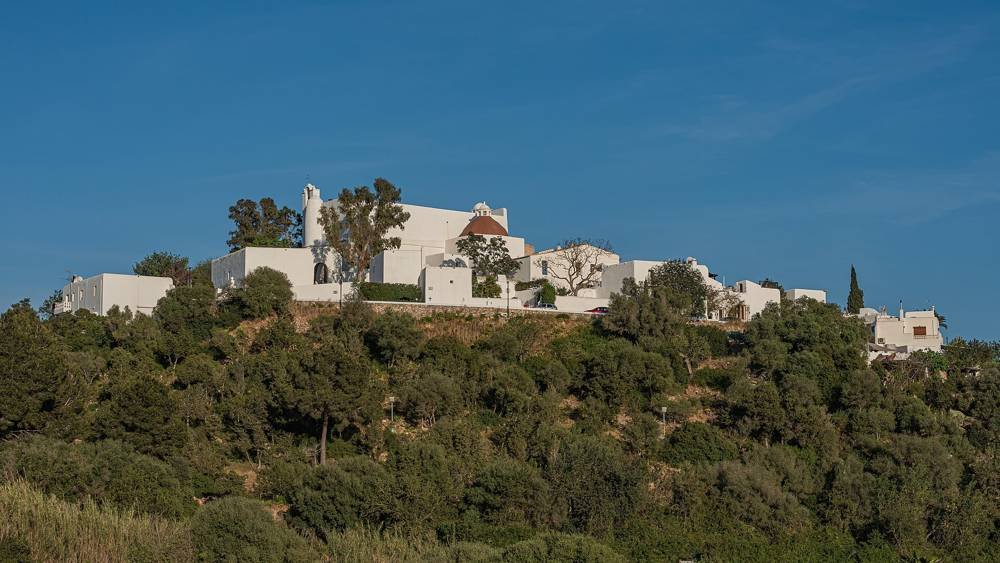
Ibiza’s rural churches were much more than places of worship. On an island of scattered homes, they hosted gatherings, celebrations and exchanges and helped give names and landmarks to large areas. Their sturdy volumes and plainness reflect both local building traditions and a context of insecurity.
The Puig de Missa in Santa Eulària clearly expresses that relationship between height, visibility and protection. The churches of Sant Miquel and Sant Antoni also have a history of extensions and uses that cannot be explained by looking only at their whitewashed façades. Today’s buildings are the result of centuries of change, and not all were born in the shape they show now.
Santa Eulària also keeps the legend of a church that supposedly collapsed towards the sea just after the faithful had left Mass. Tradition sees the absence of victims as a miracle and links it to the festival on the first Sunday in May. This is legendary memory, not an archaeological chronicle proven in every detail. Its persistence shows how religious history intertwines with landscape and calendar: a community can remember its relationship with the sea through a story that combines fear, gratitude and celebration.
References: [25], [27]. Back to contents
28 · 17th-18th centuries
The farmhouse and a culture built to last

Author / credit: Gerda Arendt. Wikimedia Commons: file page and original. CC0.

Rural Ibiza developed an architecture adapted to its resources, climate and ways of living together. Farmhouses often grew by adding new rooms, with thick walls, flat roofs and work areas linked to home life. Their beauty today should not hide the fact that they were built to meet needs, not designed for a postcard.
Storing harvests, processing food, keeping tools, collecting water and sheltering people and animals required careful organisation. Terraces, dry-stone walls, wells and paths were part of the same system. Women’s work sustained a fundamental part of that economy, although traditional descriptions have more often highlighted landowners or men’s tasks.
The ball pagès folk dance, traditional dress and the emprendades (gold jewellery) preserve another dimension of this world. Passing them on allowed people to express belonging and family or social differences. However, tracing a dance to an exact origin in an ancient civilisation is much harder than recognising its long tradition. The curious thing is that what is now offered as a folk show was also a way of relating to others and presenting oneself to the community. Rural culture was not a fixed backdrop: it changed with the economy, fashion, migration and the aspirations of its people.
References: [26]. Back to contents
29 · 1715-1724
The Nueva Planta decrees and the end of the old island government

Author / credit: Carmen vich. Wikimedia Commons: file page and original. CC BY-SA 4.0.

The Bourbon victory in the War of the Spanish Succession changed Ibiza’s institutional framework. The Nueva Planta decree of 1715 began replacing traditional structures with an organisation linked to the new monarchical system. The switch from the Universitat to the Town Hall was finally in place in 1724, following the provisions of the previous year.
Offices and the ways of appointing them changed. The loss of the old government came with changes in the control of key resources, including the salt pans, which became Crown property. For a society that had for centuries linked its institutions to salt revenue, this had consequences that went well beyond administrative language.
The island went on living from the land, the sea and trade, with periods of hardship and chances to adapt. Not everything that happened afterwards should be explained only as political punishment: climate, trade conditions, conflicts and the social distribution of wealth also played a part. The gap between 1715 and 1724 is a curiosity that helps us read history better: a law can mark the start of a process that takes years to work in practice. Institutions do not always disappear on the day their transformation is signed.
References: [23], [24]. Back to contents
30 · 1782 and the following decades
Town, bishopric and new parishes to organise the land

Author / credit: Gerda Arendt. Wikimedia Commons: file page and original. CC0.

In 1782 Ibiza was granted the title of city and its own diocese for Ibiza and Formentera was created. The first bishop of this new era, Manuel Abad y Lasierra, arrived with a programme of religious and territorial reorganisation. Expanding the network of parishes aimed to bring worship and administration closer to a scattered rural population and to encourage services and gatherings to cluster.
The churches of the late 18th and early 19th centuries ended up as centres around which recognisable villages would grow. Santa Gertrudis, Sant Llorenç and other villages should be read in this context of change, although each church has its own chronology. The island of isolated houses gradually built new shared landmarks without abruptly abandoning its rural structure.
A curiosity of church history is that the diocese was later formally suppressed in the 19th century, but this did not lead to a full and simple merger with Mallorca; its institutional path continued with intermediate arrangements until it was restored in 1949. The title of cathedral and its memory survived those ups and downs. A building’s history does not depend only on the date of its stones: it is also written by administrative decisions, local resistance and the way people keep naming it.
References: [14], [23]. Back to contents
31 · 1 June 1806
Antoni Riquer and the sea fight that became island memory
Author / credit: Dagullo. Wikimedia Commons: file page and original. CC BY-SA 3.0.

The fight between the xebec San Antonio, commanded by the Ibizan privateer Antoni Riquer, and the British brig Felicity holds a prominent place in Ibiza’s maritime memory. Capturing a more heavily armed opponent became a symbol of daring and knowledge of the sea. However, the episode was not an adventure without consequences: there were dead and wounded, and among those killed was Riquer’s father.
The action should be seen in the context of the wars and licensed privateering, not confused with a battle between modern states as we would understand it today. Letters of marque and commercial interests allowed private individuals to take part in maritime violence that could bring profit, prestige or ruin. Ships were both working tools and weapons.
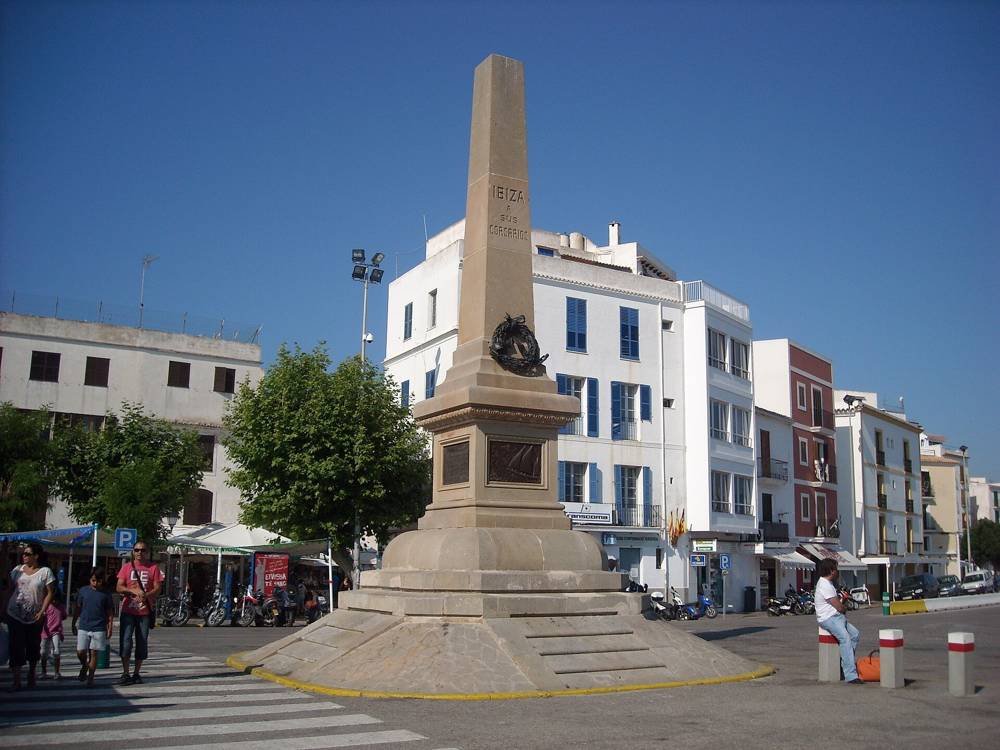
The corsairs’ monument in the port was unveiled in 1915, long after the battle. That gap in time is part of the story: a society chose what to remember and how to make it visible. It is often presented as an exceptional, even unique, monument, but absolute claims of this kind should be treated with caution. Its interest does not need a world record: it expresses the close bond between Ibizan identity and the people who risked their lives at sea.
References: [28]. Back to contents
32 · 19th century
Emigration: when seeking a future meant leaving

Author / credit: Marsan. Wikimedia Commons: file page and original. CC BY-SA 4.0.

Before receiving great flows of workers and visitors, Ibiza was also an island of emigrants. Economic limits, overseas opportunities and family networks drove departures to the Americas and elsewhere. The link with Cuba left especially visible traces in life stories, trade contacts and architectural styles that came back with some of those who had left.
Emigration did not produce a single experience. There were success stories and others of precarious work, long separations and difficult returns. Remittances and family ties could change the lives of those who stayed on the island. Nor should all emigrants be confused with the wealthy «indianos» whose houses became monuments: the visible buildings represent only part of that story.
The memory of Joaquín Vara de Rey, who died in Cuba in 1898, also adds the military and colonial dimension of that relationship with the Caribbean. His monument in the capital belongs to a public memory that should be read in its historical context. A closer curiosity appears in the architecture of Juan Gómez Ripoll, known as Campos, who brought to Ibiza what he had learned in Cuba. The white island was not built only by looking inwards: it also absorbed influences from the lives its people had made far away.
References: [29], [30]. Back to contents
33 · Second half of the 19th century
Lighthouses and navigation: lighting a connected island

Author / credit: Vicenç Salvador Torres Guerola. Wikimedia Commons: file page and original. CC BY-SA 4.0.

Modern maritime signals changed the way ships approached Ibiza. Lighthouses such as Botafoc, inaugurated in 1861, were part of a network designed to make harbour approaches and routes safer. Their light was essential public infrastructure in a place where the boat remained the main link with the outside world.
Each lighthouse responded to a specific location and needs. The history of their lenses, fuels and operating systems shows that these buildings were not static objects: they adopted technical advances and needed maintenance. The figure of the lighthouse keeper recalls a working life shaped by responsibility, supplies and, at some sites, isolation.
It is worth keeping their dates apart. The distinctive Punta Moscarter lighthouse, so photogenic in the north, dates from the 20th century and should not be used as evidence of a 19th-century building. Present-day images can illustrate the history of navigation if the caption correctly identifies the place and its period. The curious thing about lighthouses is that, designed to guide those at sea, they have become destinations for people exploring the island by land. Their role in the landscape came after their technical purpose.
References: [63], [60]. Back to contents
34 · 1867
The archduke who toured Ibiza on muleback

Author / credit: Miquel Cabot (photographic reproduction). Wikimedia Commons: file page and original. CC BY-SA 4.0.

On 11 August 1867 Archduke Ludwig Salvator of Austria arrived in Ibiza, a young traveller who would make an exceptional contribution to knowledge of the Balearics. He travelled under a low-key identity and toured the island observing its geography, economic activities, customs and people. Journeys overland and trips in fishing boats took him to very different places.
His work would become part of Die Balearen, a work of enormous documentary value. Its descriptions and images preserve aspects of island life before the great tourist transformations, although they should also be read from the observer’s position: a wealthy foreign aristocrat with scientific interests and local helpers.
The anecdote of the mule captures the distance between that visit and modern tourism. Getting to know the island required time, slow journeys and reliance on the knowledge of those who lived there. Ibizan informants were not a minor element: they supplied data, contacts and explanations essential to the result. Often only the famous visitor is remembered, when the knowledge produced also belongs to those networks of collaboration. His pages help us see an Ibiza that was not yet a mass destination but already aroused international curiosity.
References: [30]. Back to contents
35 · 1903-1907
Archaeology uncovers another Ibiza beneath everyday Ibiza

Author / credit: Falconaumanni. Wikimedia Commons: file page and original. CC BY-SA 3.0.

The founding of the Sociedad Arqueológica Ebusitana in 1903 and of the Archaeological Museum in 1907 opened a new chapter in the island’s relationship with its past. Excavations gathered objects that showed the importance of Phoenician and Punic Ibiza and gradually built reference collections. Heritage stopped being just a ruin in a field or a chance find and became an object of research and display.
The discovery and study of the es Culleram sanctuary in 1907 was decisive in making Tanit widely known. The terracottas and other finds linked a place in the north of the island with the great Mediterranean cultures. However, excavation methods in the early 20th century were not those of today: complete and eye-catching pieces were especially prized, while some contextual information could be lost.
The museum’s history is also one of insufficient space, postponed projects and changing criteria. The future Puig des Molins museum would go through decades of difficulties before opening. That path reveals a curiosity rarely seen when looking at a display case: preserving an object takes much more than finding it. It needs documentation, restoration, storage, research and a community that considers it important to pass it on.
References: [31], [32]. Back to contents
36 · 1932-1933
Walter Benjamin, Hausmann and the avant-garde travellers

Author / credit: JanManu. Wikimedia Commons: file page and original. CC BY-SA 3.0.

Before the word hippie defined an international image of Ibiza, the island was already attracting writers, photographers and artists linked to the European avant-garde. Walter Benjamin spent time in Sant Antoni in 1932 and 1933; Raoul Hausmann and Erwin Broner would be part of a cultural scene shaped by travel, creative searching and, in some cases, the need to get away from the rise of Nazism.
Rural architecture, the light and a relatively cheap life offered opportunities to work and observe. But not everyone came for the same reasons or had an idyllic experience. The outsider’s eye could find freedom where local people saw material hardship, distances and demanding routines. That difference in perspective matters, so that some people’s poverty is not turned into a mere aesthetic paradise for others.
Benjamin’s stay is linked to his writing and to a particular attention to stories and everyday experience. The memory kept in Sant Antoni places him in a landscape that would later change profoundly. The curious thing is that part of Ibiza’s cultural fame grew from its apparent remoteness from the great centres, at the very time when Europe was driving many of its creators into exile.
References: [33]. Back to contents
37 · 1933
Hotels and the Tourism Board: the pre-war tourism project

Author / credit: Robert Paul Young. Wikimedia Commons: file page and original. CC BY 2.0.

Organised tourism did not begin in the 1960s. In 1933 there was a cluster of hotel and promotional initiatives that shows a local will to open the island to new visitors. The Gran Hotel, later the Montesol, became one of the symbols of that ambition, along with establishments in Santa Eulària and Sant Antoni.
That same year the Ibiza Tourism Board (Fomento del Turismo) was founded. Merchants, hoteliers and other promoters understood that the landscape and the island’s distinctive features could create a new economic activity. Access still depended mainly on the boat, and visitor numbers were very different from those that would come with flights and package holidays.
The Montesol holds a curiosity that links two chapters of history: its colonial-style architecture was the work of Juan Gómez Ripoll, known as Campos, who had lived in Cuba. A building associated with tourist modernisation also came from Ibiza’s emigrant experience. Its terrace would bring together people of many backgrounds and social positions. The war cut short that first drive, but it did not erase the existence of entrepreneurs and residents who had already imagined tourism as the future. The later transformation had precedents, decisions and local players; it did not come only from outside.
References: [34], [29]. Back to contents
38 · 1936
The Civil War: landing, bombing and a lasting rift

Author / credit: Michela Simoncini from Firenze, Italy. Wikimedia Commons: file page and original. CC BY 2.0.

The military coup of July 1936 upended political and social life in Ibiza. In August the Republican expedition linked to Alberto Bayo and Manuel Uribarri occupied the Pitiusas for a brief period. The island experienced arrests, violence and changes of authority, within a war whose local outcome was decided early but whose consequences would last for decades.
13 September was marked by bombing raids by the Italian air force supporting the rebels and by the killing of prisoners held in the castle at the hands of militiamen. Published figures and the definition of some episodes vary; it is therefore better to describe the gravity of the massacres without giving a single number as if there were no historical debate. After the rebel forces retook the island, Francoist repression followed, affecting people and families in different municipalities.
These events should not become a picturesque anecdote within a tourist narrative. The island’s memory includes victims, silences and inequalities in public recognition. Research and remembrance work have recovered names and experiences long pushed aside. Knowing Ibiza’s history means facing that pain too, avoiding both justification of the crimes and an automatic equivalence that erases their contexts and responsibilities.
References: [36], [37], [38]. Back to contents
39 · 1940s and early 1950s
The post-war years: surviving before the tourist boom

Author / credit: Jim Bowen. Wikimedia Commons: file page and original. CC BY 3.0.

Today’s image of an island associated with spending and leisure can make the post-war years hard to grasp. During that time many families depended on a mix of farming, livestock, fishing, small-scale trade and domestic work. Restrictions, supply problems and political surveillance limited the chances of recovery and of moving on.
The rural economy kept providing food and resources, but it also demanded constant effort. Tools, clothes and materials were used for a long time; mending was not an aesthetic choice. Family and neighbourly ties could provide help, though they did not remove social differences or the unequal burdens between men and women.
Pre-1936 tourism had been cut short by the Civil War and then by the Second World War. Its recovery was gradual and required rebuilding confidence, transport and accommodation. It is important to keep that sequence in mind: the later leap did not start from an island without economic history, but from a society that already traded, emigrated and tried out new activities. The most revealing curiosity is how close in time it all was: many people who knew scarcity and the land as their main horizon witnessed, in a single lifetime, the arrival of hotels, planes and visitors from all over the world.
References: [35]. Back to contents
40 · 1954
Las Dalias before the markets: a village bar and a dance floor

Author / credit: Juan Marí Juan family archive. Wikimedia Commons: file page and original. CC BY-SA 4.0.

Las Dalias opened in Sant Carles in 1954, long before it became one of Ibiza’s best-known markets. It began as a family business built around the bar, gatherings and music. The project of Juan Marí Juan and Francisca Juan Juan grew in step with the needs and possibilities of a rural community that was beginning to change.
Dances and performances brought in new things without immediately erasing village life. The arrival of visitors and new residents gradually widened the audience and the uses of the place. The later transformation cannot be understood as the sudden appearance of a hippie stage set: it had a local base and a process of business and cultural adaptation.
The curious thing is that the market, now inseparable from the name Las Dalias, was not born with the business. It would appear decades later. Separating the two dates shows how landmark places are built: a well-known brand ends up condensing several stages until it seems it was always the same. In reality its history brings together a family, workers, craftspeople, musicians and visitors. Before appearing in photographs all over the world, Las Dalias was a place where neighbours could meet and share in the new forms of leisure reaching the island.
References: [39]. Back to contents
41 · 1958 and the following years
The airport changes Ibiza’s scale

Author / credit: serge Ottaviani. Wikimedia Commons: file page and original. CC BY-SA 3.0.

The opening and consolidation of commercial air traffic in 1958 transformed access to Ibiza. The airport had military origins and a first civil opening in 1949 that did not continue without interruption. So its history is not correctly summed up by saying that before 1958 no plane had ever landed there or that there had been no civil activity.
Regular connections reduced dependence on sea travel and allowed far more people to come and go. Later improvements to runways, terminals and facilities kept pace with growing demand. Each expansion also reflected a new idea of what the island could receive and how it should connect with Spain and Europe.
The plane was decisive, but it did not act alone. Tour operators, paid holidays, rising incomes in the visitors’ home countries and hotel investment turned accessibility into large-scale tourism. For local people it meant jobs and business opportunities, along with new pressures on land, water and services. The historical curiosity is that infrastructure first linked to military needs ended up as one of the most influential tools in the island’s civil, economic and cultural transformation.
References: [40], [35]. Back to contents
42 · From 1959
Ibiza 59 and Broner: an island within the international avant-garde

Author / credit: JanManu. Wikimedia Commons: file page and original. CC BY-SA 4.0.

The founding of the Ibiza 59 group and the work of artists from different backgrounds established the island as a place of contemporary experimentation. Erwin Broner, Erwin Bechtold, Hans Laabs and others were part of a scene that connected island life with European artistic debates. Culture was not a later add-on to the tourist industry: it was part of how Ibiza presented itself to the world.
Casa Broner, in sa Penya, reveals its author’s double role as architect and artist. Its relationship with light, sea and domestic space shows a modernity that engaged with the place instead of simply copying a farmhouse. Traditional architecture had interested many observers; modern creators reinterpreted it through their own questions.
The contrast between a materially modest island and ambitious artistic output is especially fruitful. Studios, friendships and exhibitions built a network that outlasted the visiting seasons. Not all foreign residents were tourists, and not all international activity was about leisure. The curious thing is that, just as rooms for visitors began to multiply, an artistic heritage was also taking shape that would allow Ibiza to be explained through painting, architecture and abstraction.
References: [33], [41]. Back to contents
43 · 1960s
The tourist boom: a transformation lived from within
Author / credit: Joselodos. Wikimedia Commons: file page and original. CC0.

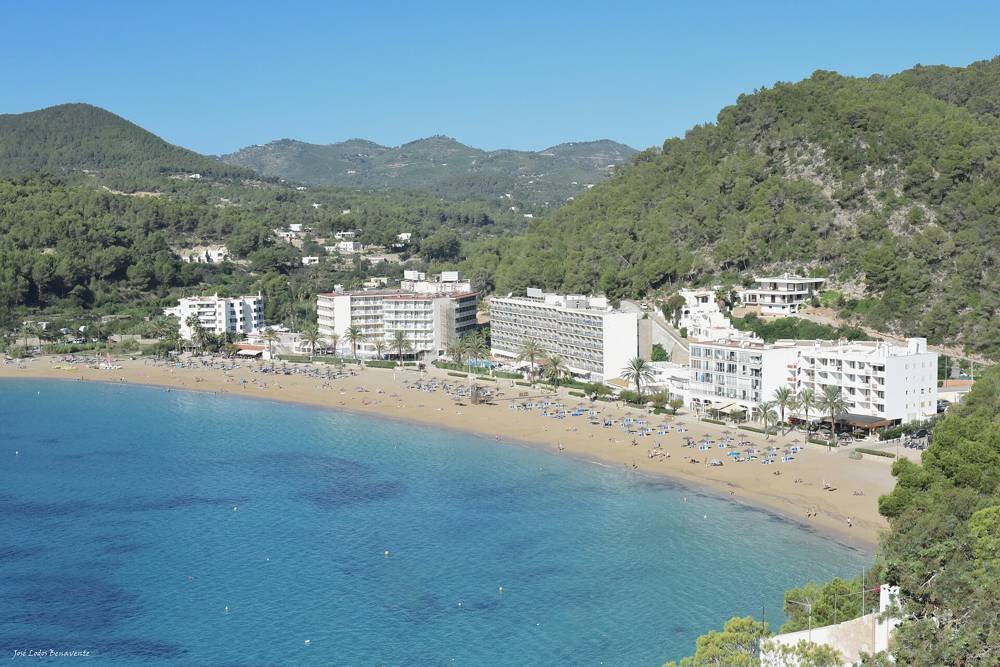
In the 1960s tourism rapidly changed the economy and the land. Hotels were built, businesses opened and jobs in accommodation, catering, transport and construction multiplied. Parts of Sant Antoni, Santa Eulària, Platja d’en Bossa and other coastal spots grew at different speeds and in different ways.
Local people’s involvement was fundamental. Families who had lived off the land invested, gave up plots, changed jobs or combined activities. Workers also came from other parts of Spain and, later, from many countries. The history of tourist development cannot be reduced to foreign entrepreneurs discovering a passive island: there were local decisions, unequal benefits and new paths of social mobility.
The road to Cala de Sant Vicent shows the scale of change. A relatively remote area could be drawn into visitor and service circuits in a way that had been difficult before. However, better access also changed land values and how the coast was used. The most important curiosity is not a record figure but the speed: within a few years, places tied to fishing and farming began organising their calendar around seasons, bookings, flights and the expectations of an international clientele.
References: [35], [34]. Back to contents
44 · From the mid-1960s
The hippies: freedom sought, coexistence and contradictions

Author / credit: Cordula Schott. Wikimedia Commons: file page and original. CC BY 2.0.

The arrival of the hippies added a new layer to Ibiza’s image. Young Europeans and Americans found an island with earlier foreign communities, country houses and places relatively far from the centres of control in their home countries. Some sought communal living, others artistic experimentation, distance from war or a break with social norms.
Their presence did not create the island’s openness out of nothing. It built on earlier relationships and conditions, and coexisted with a local society that had its own values. Everyday tolerance did not mean an absence of conflict or surveillance: Ibiza was still part of a dictatorship. The clash between the image of freedom and that political framework is one of the keys to the period.
Music gatherings, crafts and new ways of dressing became part of the island’s visible culture. Benirràs keeps an especially strong association with that imagery, though a modern photograph of drummers does not document an event from the 1960s. The curious thing is that the counterculture also ended up as a tourist marketing tool. What set out to step away from conventional consumption helped build a very powerful commercial image, a paradox that would follow Ibiza through the decades that followed.
References: [35], [33]. Back to contents
45 · 1969
The MACE and an island also told through art and film

Author / credit: fnogues from Eivissa. Wikimedia Commons: file page and original. CC BY-SA 2.0.

The opening of the Museu d’Art Contemporani d’Eivissa in 1969 gave institutional form to the creative scene that had developed on the island. Its origins lie in the Ibiza Biennial, begun in 1964, and in prize-winning works, donations and loans. The museum was born when contemporary art still had limited institutional space in many Spanish cities.
The island was also entering the international film imagination. More, by Barbet Schroeder, released in 1969 with music by Pink Floyd, fixed an image of searching, desire and self-destruction linked to the counterculture. A film should not be confused with a neutral description of Ibizan society: its characters and plot build a particular point of view.
The MACE offers a curiosity that sums up the island’s layers of time. During its extension, remains of Punic houses were uncovered and built into the visit under transparent floors. Visitors can thus connect 20th-century art with a city more than two thousand years old. Few images explain Ibiza’s history better: an institution born to look towards the avant-garde ended up showing, beneath its own floors, part of the world that came before it.
References: [41], [42], [43]. Back to contents
46 · 1971
Adlib: tradition becomes a new way of dressing

Author / credit: Joan Gené. Wikimedia Commons: file page and original. CC BY-SA 4.0.

Ibiza’s first Fashion Week, held in 1971, marked the birth of Adlib as a recognisable style. The initiative led by Smilja Mihailovitch combined the influence of local dress with the freedom of shapes and materials associated with the new residents and visitors. Ibizan fashion stopped being just a way of dressing on the island and became a language that could travel.
Fabrics, embroidery, lace and handcraft met lighter garments and new expectations of comfort. Adlib was not a simple copy of traditional country dress, nor a synonym for any white dress. Its historical interest lies precisely in the transformation: elements of one culture were reinterpreted to suit another social and commercial context.
The name comes from the Latin expression ad libitum, associated with freedom of choice. The well-known motto «dress as you like, but with taste» summed up that aspiration and became one of its hallmarks. The curious thing is that an image of spontaneity needed organisation, designers, workshops and promotion. Behind the apparent naturalness lay professional work and craft skills, largely those of women. Adlib shows how the tourist economy could also generate its own cultural production, able to project the island without reducing it to its beaches.
References: [44]. Back to contents
47 · 1973
Pacha arrives in Ibiza and links the island with Sitges

Author / credit: Dominic Milton Trott. Wikimedia Commons: file page and original. CC BY 2.0.

The opening of Pacha Ibiza in 1973 introduced a name that would become internationally identified with the island’s nightlife. The brand had a direct forerunner in Sitges, where Ricardo Urgell had opened the first Pacha in 1967. That link is a reminder that Mediterranean leisure culture grew through networks of people, businesses and experiences, not within completely separate destinations.
The Ibiza club presented itself with architecture evoking a local house and grew alongside the island’s musical fame. Its history belongs to a broader transformation: dancing and line-ups stopped being an occasional extra on holiday and became one of the reasons to travel.
The club created jobs, drew diverse crowds and contributed to an image of sophistication and freedom. It was also part of a model that needed transport, accommodation, security and a complicated relationship with the sleep of those who lived nearby. The curiosity of the cherries, a symbol recognisable beyond any language, shows the power of a brand. Pacha did not invent Ibiza’s nightlife, nor was it its only protagonist, but it helped turn an experience rooted in a specific place into an exportable image.
References: [45]. Back to contents
48 · From 1976
Amnesia and the Balearic sound: a way of mixing the world

Author / credit: Andrew Woodvine. Wikimedia Commons: file page and original. CC BY-SA 2.0.

The opening of Amnesia in 1976 added another key venue to Ibiza’s musical history. The story of its spaces and the DJs who worked there is linked to the growth of a dance culture that was not confined to a single genre. In some sets, very different styles could sit side by side, chosen for their ability to build a sequence and an atmosphere.
Alfredo Fiorito holds a prominent place in the memory of the Balearic sound. The influence of these practices on visitors and future foreign promoters helped connect the Ibiza experience with music scenes in other countries, especially the United Kingdom. That exchange was decisive: visitors took home records, ideas and ways of organising nightlife that later came back transformed.
The club’s own architecture holds a historical curiosity. What is now known as the Terrace was for years a genuinely open-air space, before changes that altered the relationship between music, daylight and soundproofing. The night remembered as spontaneous also depended on specific physical conditions. As the business grew, opening hours, technology and regulations changed. The Balearic sound was not born from a particular machine but from a combination of people, places, records and encounters.
References: [46], [47]. Back to contents
49 · From 1979
Democracy, the Consell and the return of island self-government

Author / credit: A.Savin, Wikipedia. Wikimedia Commons: file page and original. FAL.

The transition to democracy opened a new era of political participation. In 1979 the Consell Insular d’Eivissa i Formentera was set up, alongside democratically elected town councils. The institution gave the two islands their own forum to manage their affairs and was later integrated into the Balearic regional framework.
The return of representative bodies coincided with a society profoundly transformed by tourism and migration. Governing meant facing new needs in roads, planning, culture, services and protecting the land. Decisions about growth stopped being only a matter for private initiative or central government: they became part of a more visible island political debate.
Democracy did not end conflicts between development models. It allowed them to be voiced, associations to be formed and public debate on what should be preserved and what could change. The island’s own language and culture also gained new spaces of recognition. The historical curiosity is the coexistence of a very recent institution with a much older tradition of island government. The Consell was not the medieval Universitat brought back to life, but the idea that the island needs its own political voice found a new framework. Since then, much of Ibiza’s history can be read in decisions about how to share out opportunities and limits.
References: [48], [49]. Back to contents
50 · From 1980
Café del Mar: turning a sunset into musical culture

Author / credit: A.Savin, Wikipedia. Wikimedia Commons: file page and original. FAL.

Café del Mar opened in Sant Antoni in 1980 and ended up giving its name to a way of accompanying the sunset with music. The combination of landscape, music selection and social gathering turned an everyday experience —watching the sun go down over the sea— into an internationally recognised ritual.
The architecture by Lluís Güell and the later influence of DJs such as José Padilla contributed to that identity. Compilation albums spread beyond the island a repertoire associated with calm, transition and a kind of listening less focused on the intensity of the dance floor. Not all of Ibiza’s musical history took place at high volume or indoors.
The curious thing is that the «sound of a sunset» does not exist naturally: it is built from cultural choices, expectations and shared memories. The same landscape can be experienced in very different ways, and music turned that spot into a recognisable experience that could later be recalled through a recording. Success brought imitations and expanded the brand, but it also concentrated visitors in particular parts of the coast. Ibiza’s seemingly quietest image was as much a part of building an international leisure industry as its big clubs.
References: [50], [51]. Back to contents
51 · 1983-1987
Pikes and star-studded Ibiza: Wham!, Mercury and Caballé

Author / credit: Carl Lender. Wikimedia Commons: file page and original. CC BY-SA 3.0.

Pikes hotel became one of the best-known settings of the Ibiza associated with musicians and celebrities. Wham!’s Club Tropicana video, filmed there in 1983, spread an image of pool, sun and carefree living that reached audiences who might not have been able to find the island on a map. The screen extended the promotional reach once held by travel books and postcards.
In 1987 Freddie Mercury celebrated his 41st birthday at Pikes, another episode that became part of the hotel’s memory. Anecdotes about guests and parties multiplied over time, but not every detail repeated in later accounts is equally well documented. The main events having happened does not mean accepting every spectacular figure or embellished story.
The Ku club also hosted the presentation of Barcelona by Freddie Mercury and Montserrat Caballé in May 1987, as part of Ibiza 92. A contemporary report describes a mimed performance. The meeting of a great soprano and a rock star made Ibiza the stage for a collaboration that would become associated with Barcelona’s Olympic imagery years before the Games.
These episodes matter beyond the curiosity of seeing celebrities. They show how Ibiza became part of circuits of music production, music videos and international socialising. A famous person could be visitor, customer, creator and promoter all at once. They also remind us that landmark places usually rely on relationships of hospitality and on local people or residents able to create an atmosphere. Global fame rested on very specific encounters.
References: [52], [64], [65]. Back to contents
52 · From 1985
The markets: crafts, counterculture and economic activity

Author / credit: DetFerMai. Wikimedia Commons: file page and original. CC BY-SA 4.0.

The Las Dalias market began in 1985, launched by Juanito Marí and Helga Watson-Todd at a venue that had been running for three decades. Its first stalls were the start of an activity that would grow into one of the most recognisable images of Sant Carles and of the island.
The markets brought together crafts, clothes, decorative objects, music and ways of socialising associated with the counterculture. They were also workplaces. For many stallholders, making, choosing and selling goods was an everyday livelihood, not a theatrical performance of hippie life. The arrival of large crowds changed the scale, services and organisation.
In other areas, such as Punta Arabí, there were separate initiatives that should not be confused with the Las Dalias chronology. Speaking of «the Ibiza hippie market» as if there were only one erases that diversity. The curious thing is that the object bought usually carries a story as well as a material: someone visiting a stall may feel they are acquiring a piece of island identity. That symbolic power has been a commercial strength, but it also raises a persistent question about authenticity, local production and imported goods. Living culture changes; that is precisely why it is worth knowing who makes what is sold and what connection they have with the island.
References: [39]. Back to contents
53 · 1999
World Heritage: a history that also lies under water

Author / credit: Jc REY from Aix-en-Provence, France. Wikimedia Commons: file page and original. CC BY-SA 2.0.

The inscription of «Ibiza, Biodiversity and Culture» on UNESCO’s World Heritage List in 1999 recognised an exceptional combination of cultural and natural values. It did not mean that every building and every metre of the island automatically received the same protection: the listing refers to a defined property and areas.
Sa Caleta, Puig des Molins and the fortifications of Dalt Vila account for part of that recognition. Alongside them, the marine ecosystems and meadows of Posidonia oceanica show that the history of the land cannot be separated from the environment that sustains it. The relationship between sea and coast is part of the value of the whole.
The most important curiosity is that a marine plant shares heritage billing with tombs and walls. Posidonia is not seaweed but a plant with roots and leaves that forms meadows that shelter life and help shape the coastline. Its presence helps explain why clear water and the health of beaches depend on processes not always visible from the surface. The international listing brought recognition but also responsibility: heritage prestige does not by itself guarantee good conservation or resolve the tensions of tourist growth.
References: [53], [54]. Back to contents
54 · 2001
Ses Salines: protecting a landscape worked for centuries

Author / credit: UnFUG-Fabi. Wikimedia Commons: file page and original. CC BY-SA 4.0.

The designation of the Ses Salines d’Eivissa i Formentera Natural Park in 2001 strengthened protection of an area that brings together land and sea on both islands. Its distinctiveness comes from the combination of salt pans, beaches, dunes, seabed and habitats used by many species.
The park shows that nature and history are not incompatible categories. Salt production shaped channels, basins and paths; birds found opportunities in that managed landscape; seagrass meadows and dune systems are part of ecological processes connected with the coast. Protecting the whole means paying attention to those relationships, not just preserving a pretty view.
Flamingos have become one of its most appealing images, but environmental value is not limited to one photogenic species. Inconspicuous organisms, water conditions and continuous habitats also matter. The curious thing is that a very old economic activity and a modern environmental policy meet in the same place, though their aims are not identical. Management must balance conservation, salt production, access and public use. On an island transformed by tourism, ses Salines expresses a decisive idea: not all of a place’s value can be measured by how intensively it is built on or visited.
References: [61], [53]. Back to contents
55 · 2007
Ibiza and Formentera: two councils for a shared history

Author / credit: Charles from Port Chester, New York. Wikimedia Commons: file page and original. CC BY 2.0.

The 2007 reform of the Statute of Autonomy gave Formentera its own Consell and reshaped the Consell d’Eivissa. This ended the era of the joint council created in 1979. Institutional separation acknowledged different needs and scales without erasing a historical relationship woven over centuries.
The bond between the Pitiusas has involved shared power structures, movement of people, trade, family ties and shared services. However, Formentera is not simply an administrative extension of Ibiza, nor can its historical episodes be transferred to the larger island without saying so. Distinguishing the two improves understanding of both.
Daily sea connections are a reminder that political decisions coexist with practical ties that still cross the water. Working, studying, using services or visiting relatives make visible a closeness that is more than a line on a map. The curiosity of 2007 is that a seemingly administrative reform reorganised a long-standing tradition of government while keeping the need for cooperation. In Ibiza’s history, being an island does not mean being alone: it also means belonging to a small system of islands that negotiate their autonomy and their ties.
References: [48], [49]. Back to contents
56 · From 2011
Hotels, big stages and the shift towards luxury experiences

Author / credit: Phil Guest. Wikimedia Commons: file page and original. CC BY-SA 2.0.

The opening of Ushuaïa Ibiza Beach Hotel in 2011 symbolised a new combination of accommodation and live music. The hotel could also be a stage, a leisure brand and the main reason for the trip. The change did not come out of nowhere, but it reinforced a trend towards packaged products, high-profile events and services aimed at higher-spending visitors.
During the 2010s investment and offerings linked to luxury, gastronomy, beach clubs and digital promotion multiplied. Social media also changed how people choose and show off a destination: a shared image could spread instantly far beyond the reach of traditional media.
This process created jobs, business activity and new career opportunities, but it also made more visible the gap between the price of the tourist experience and the income of part of the resident population. The curious thing is that a brand built on freedom, simplicity and counterculture could coexist with a market of exclusivity and access determined by spending power. There is no single social Ibiza. International success rests on workers, infrastructure and resources that also need space to live and operate outside the tourist shop window.
References: [62]. Back to contents
57 · From 2018
Posidonia and the ecological limits of prosperity
Author / credit: Tigerente. Wikimedia Commons: file page and original. CC BY-SA 3.0.

Specific protection for Posidonia oceanica in the Balearics received a new framework with the regional decree of 2018. That legal recognition reflected a long-standing concern: seagrass meadows suffer pressure from improper anchoring, declining water quality and changes to the coastline, among other factors.
Ibiza’s history cannot end with a description of its economic successes. Water use, waste-water treatment, energy, rubbish and transport are part of the material life of an island with limited resources and space. Technical solutions are necessary, but they do not remove the question of the scale of demand and how its costs are shared.
One curiosity helps change perspective: the posidonia remains piled up on the beach are not necessarily dirt. They are part of natural processes and can help protect the coast from erosion. The expectation of permanently spotless sand does not always match the ecosystem’s needs. Understanding this difference connects the visitor’s experience with a longer history of adapting to the environment. The beauty that drew generations of travellers depends on living systems; preserving it takes more than reproducing its image in a campaign.
References: [55], [54]. Back to contents
58 · 2020
The pandemic: an interruption that revealed dependence on tourism

Author / credit: Chixoy. Wikimedia Commons: file page and original. CC BY-SA 3.0.

The covid-19 pandemic caused an exceptional break in Ibiza’s mobility and economic activity. Travel restrictions and the closure or reduction of many activities hit hotels, restaurants, nightlife, transport and jobs. An economy used to organising much of its year around the season faced uncertainty on an international scale.
The fall in air traffic reflected that interruption. However, the airport and sea links kept public-service, supply and communication roles that cannot be reduced to carrying tourists. The island still needed to look after its people and keep its essential services running.
The temporary absence of large flows of visitors produced unusual images, but it should not be idealised as a shared happy experience. Behind a quiet beach there might be a family with no income or a business close to closing. The recovery that followed brought back activity and work, while reopening debates on dependence and diversification. The historical curiosity is that, for a short period, an outside factor disrupted almost every part of the tourist model at once. The pandemic made it especially clear how far Ibiza’s daily life was connected to decisions, risks and economies far beyond its shores.
References: [56]. Back to contents
59 · 2021-2026
Recovery, housing and the right to keep living on the island

Author / credit: Gerda Arendt. Wikimedia Commons: file page and original. CC0.

The recovery of tourism brought energy back to Ibiza, but it also intensified debates that had been building for years. Access to housing became a central concern for residents and workers. Population growth, seasonal demand, property investment and available supply combine in an especially complex way on limited land.
Not all the problems can be put down to a single cause or solved with a single measure. The difficulty of finding somewhere to live affects families, young people, tourism workers and essential-service professionals. The situation reveals an important contradiction: a destination can generate a great deal of activity and, at the same time, make it hard for the people who keep it running to stay.
The public assessments and affordable-housing proposals of these years are part of a story that is still unfolding. It is important to distinguish between announced projects, works under way and homes actually available, without presenting planning as if it were an achieved result. The curious thing is that the word «resident» now covers very different life stories: people from Ibizan families, newcomers from other regions and new inhabitants from many countries. The island’s continuity does not lie in freezing its population, but in allowing that community to lead a stable life, look after its ties and pass on its heritage.
References: [57]. Back to contents
60 · 2025-2026
Managing the flows and deciding the future: the Ibiza of our time

Author / credit: NASA/JSC, Expedition 35 crew. Wikimedia Commons: file page and original. Public domain.

The introduction in 2025 of a system to regulate the number of vehicles, with agreements to apply it in 2026 as well, marks a significant shift in public debate. After decades in which increasing access and capacity seemed the main goal, the island is discussing how to manage limits. Mobility is tied to the use of roads, parking, public space and quality of life.
Regulating vehicles does not on its own solve housing, water or conservation, but it shows that growth needs to be governed. Specific measures can change over time; that is why a general history should explain their purpose and refer readers to official information for current conditions, rather than turning a history chapter into an administrative guide that will soon be out of date.
Today’s Ibiza keeps its local language and traditions, a multicultural community, an international economy and a heritage ranging from archaeological sites to underwater meadows. Its future is not written. It will depend on decisions about how to welcome visitors, sustain services, protect the land and allow its people to go on living there. After thousands of years of arrivals and transformations, the question is not whether the island will change, but which changes it wants to promote and which inheritances it considers non-negotiable. That debate is also part of its history.
References: [58], [59]. Back to contents
Sources and references
The narrative combines archaeological research, institutional documents, historical studies and contemporary sources. Each chapter’s references point to this list. Sources from businesses are used for their own historical milestones, not as independent assessments of their services.
- Geology of es Vedrà and es Vedranell. Geolodía 2018. Sociedad Geológica de España / Universitat de les Illes Balears.
- Sites of geological interest: es Vedrà. Govern de les Illes Balears.
- Prehistoric settlement of the Balearic Islands: the Bronze Age. Universitat de les Illes Balears.
- The secrets of the puig de s’Argentera. Museu Arqueològic d’Eivissa i Formentera (MAEF).
- Heritage route: sa Caleta and ses Païsses de Cala d’Hort. Consell d’Eivissa / Ibiza Travel.
- History of the Puig des Molins necropolis. MAEF.
- Ibiza: history and references. Wikipedia, general reference article.
- Eivissa: etymology of the place name. Institut d’Estudis Catalans, Onomasticon Cataloniae.
- Ebusus Phoenissa et Poena: the island of Ibiza in the Phoenician-Punic period. Archaeological study, available on Academia.edu.
- Vital principle: ostrich eggshells in Ibiza. MAEF.
- Feel Ibiza: heritage, the island’s north and es Culleram. Consell d’Eivissa / Ibiza Travel.
- Review on the presence of the god Bes in Ibiza. Fites 8 / Associació d’Amics del Museu Arqueològic.
- Roman Ebusus: historical and epigraphic studies. Mayurqa 2021, Universitat de les Illes Balears.
- History of the diocese. Diocese of Ibiza.
- Vincentius Ebusitanus. Real Academia de la Historia.
- Analysis of medieval burials from Ibiza reveals genetic and pathogenic diversity during the Islamic period. Nature Communications, 2026.
- Water systems and Andalusi settlements in Ibiza. Archaeological research, Universitat Autònoma de Barcelona repository.
- Environmental recovery of ses Feixes: hydrological and ecological assessment. Alianza por el Agua.
- Liber Maiolichinus: chronicle of the Pisan expedition. Wikipedia, with references to the medieval text and studies.
- Madina Yabisa interpretation centre. Ibiza Travel.
- Three walks around Dalt Vila. Consell d’Eivissa / Ibiza Travel.
- Captives or Slaves and Masters in Eivissa (Ibiza), 1235–1600. Antoni Ferrer Abárzuza, Medieval Encounters, 2016.
- History of the town council. Ajuntament d’Eivissa.
- Historical report on the salt pans of the Pitiusas. Boletín Oficial del Estado, 11 January 2005.
- Culture and heritage: rural and religious architecture. Consell d’Eivissa / Ibiza Travel.
- Traditional and legendary Ibiza. Consell d’Eivissa / Ibiza Travel.
- May Festival: the tradition of the church that fell into the sea. Santa Eulària des Riu Tourism.
- Riquer defeats el Papa: the fight of 1806. Revista General de Marina, June 2006.
- Hotel Montesol and Juan Gómez Ripoll, Campos. Ajuntament d’Eivissa, Tourism.
- First journeys and the arrival of Ludwig Salvator in the Balearics. Govern de les Illes Balears, Archduke Year.
- Dalt Vila Museum: origin of the collections. MAEF.
- History of the Puig des Molins Monographic Museum. MAEF.
- Contemporary art route: Broner, Hausmann and Benjamin. Consell d’Eivissa / Ibiza Travel.
- History of the Ibiza Tourism Board. Fomento del Turismo de la Isla de Ibiza.
- Social history of tourist development in Ibiza, 1960s and 1970s. José Ramón Cardona and Antoni Serra Cantallops, 2013.
- Places of memory and Bayo’s landing. Govern de les Illes Balears.
- Democratic memory and recognition: historical background. Law 2/2018, preamble, BOE.
- The events of 13 September 1936 and their disputed figures. Periódico de Ibiza, 13 September 2026; statements by Fanny Tur.
- Las Dalias: history since 1954. Las Dalias, history of the venue.
- History of Ibiza airport. Aena.
- MACE: collection and founding of the museum. Museu d’Art Contemporani d’Eivissa.
- More, film by Barbet Schroeder, 1969. The Criterion Channel.
- More: original soundtrack and release date. Pink Floyd, official website.
- Our history: Adlib Ibiza. Adlib Ibiza / Consell d’Eivissa.
- Pacha Ibiza and its forerunner in Sitges. Wikipedia, The Pacha Group, with references.
- Amnesia: its rooms and the 1976 opening. Amnesia, history of the venue.
- DJ Alfredo and the sound of Ibiza. Amnesia, 2025.
- Consell Insular d’Eivissa i Formentera. Gran Enciclopèdia Catalana.
- Institutional reorganisation of 2007: coat of arms of the new Consell. Boletín Oficial del Estado, 2008.
- Café del Mar: history of the venue. Café del Mar, official website.
- Café del Mar: José Padilla and discography. Wikipedia, with references.
- History of Pikes Ibiza. Pikes, history of the hotel.
- Ibiza, biodiversity and culture. Spanish Ministry of Culture.
- Ibiza, Biodiversity and Culture. UNESCO, World Heritage listing.
- Decree protecting posidonia and marine areas. Govern de les Illes Balears, environmental documents.
- Environmental report for Ibiza airport, 2020. Aena / Ministry of Transport.
- Housing Observatory: presentation of data in Ibiza. Govern de les Illes Balears, 2026.
- Vehicle regulation: rules and 2026 agreements. Consell d’Eivissa / Ibiza Circular.
- First application of vehicle limits, 2025. Consell d’Eivissa / BOIB.
- Balearic maritime lighting: history of lighthouses and lenses. Autoritat Portuària de Balears / Fars de Balears.
- Designation and planning of ses Salines: Law 17/2001. Govern de les Illes Balears.
- Ushuaïa Ibiza: opening in 2011. Ushuaïa Ibiza, official website.
- Botafoc lighthouse: history and inauguration date. Autoritat Portuària de Balears / Fars de Balears.
- Presentation of Barcelona at Ku, May 1987: contemporary report. Jacinto Antón, El País, 31 May 1987.
- Barcelona: the story of the collaboration with Montserrat Caballé. Freddie Mercury, official website.
Images and credits
Each image keeps its own authorship and licence. Size and compression have been adapted, without generating images with AI or altering their content. Present-day photographs of places and objects are distinguished from historical reproductions. Portraits and documents are identified as such.
Ancient dates may be approximate and some aspects are still being researched. Legendary accounts are presented explicitly as traditions. The contemporary part is up to date as of 26 October 2026.