Eivissa Sí › Ibiza Town › History
History of Ibiza Town
Nearly three thousand years of history: Phoenician Ibossim, Roman Ebusus, Moorish Madina Yabisa and the walled Christian town.
From the Phoenicians to Rome
Ibossim
The Phoenicians founded the city in the 7th century BC on the sheltered bay of the harbour, after the first settlement at Sa Caleta.
Punic city
Linked to Carthage, the city minted coins showing the god Bes and buried its dead at Puig des Molins.
Ebusus
After the Punic Wars it joined the Roman world and remained a busy port.
From Madina Yabisa to the conquest
Madina Yabisa
In Moorish times the city had three walled enclosures, part of whose outline Dalt Vila still follows.
1235
On 8 August Catalan troops took the city; the date is celebrated every year on Sant Ciriac.
Self-government
For centuries the island was governed from the town through its own institutions.
From the walls to today
16th century
Philip II ordered the new Renaissance walls, one of the finest examples of military architecture of the time.
City and bishopric
In the 18th century the diocese of Ibiza was created and the main church became a cathedral.
World Heritage
In 1999 UNESCO listed Dalt Vila, Puig des Molins, Sa Caleta and the posidonia as “Ibiza, Biodiversity and Culture”.
Every place in Ibiza Town
Filter by type. Each place has its own page with address and map.
Ibiza Town
Dalt Vila walls
A 16th-century Renaissance walled town with seven bastions, World Heritage since 1999. Enter through the Portal de ses Taules and walk the perimeter, free and at any time.
Ibiza Cathedral (Santa Maria de les Neus)
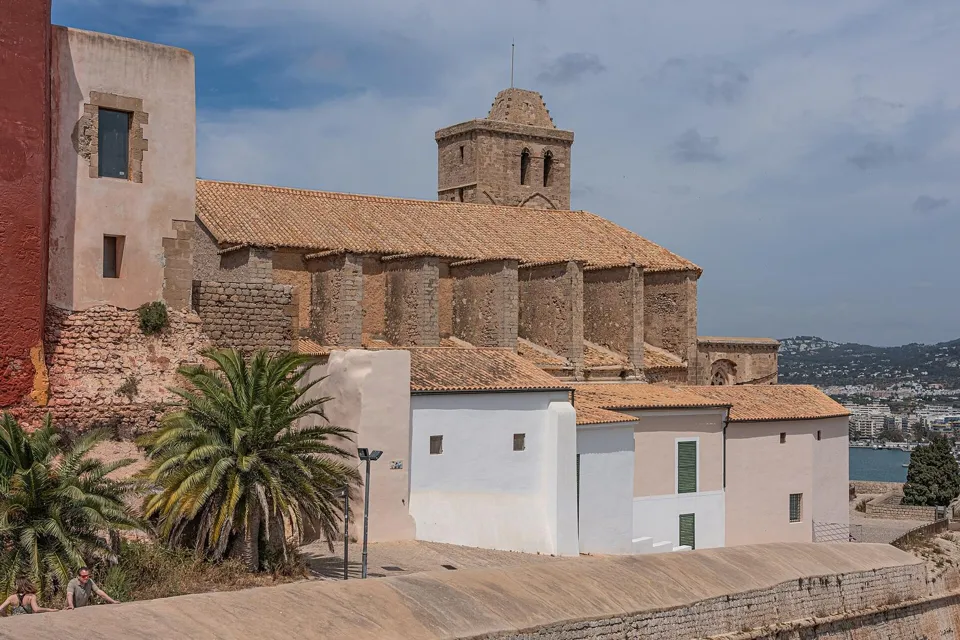
At the top of Dalt Vila, built after the Catalan conquest of 1235 on the site of the old mosque, with a Gothic bell tower and Baroque nave. The square looks over the whole harbour.
Puig des Molins necropolis and museum
The best-preserved Phoenician-Punic necropolis in the Mediterranean, with thousands of tombs cut into the hill, and a museum of grave goods and terracotta figures. The open site of the Ibiza and Formentera Archaeological Museum; free entry.
Hours change with the season: check before you go.
MACE, Museum of Contemporary Art
In the old armoury by the Portal de ses Taules, with contemporary art linked to the island since the 1950s and Phoenician remains under a glass floor. Free entry; closed on Mondays.
Hours change with the season: check before you go.
Museu Puget
A Gothic house in Dalt Vila showing the work of painters Narcís Puget Viñas and Narcís Puget Riquer, portraits of early 20th-century Ibiza. Free entry.
Hours change with the season: check before you go.
Madina Yabisa interpretation centre
In the Cúria building, it tells the story of Muslim Ibiza (10th-13th centuries), with remains of the Moorish wall and audiovisuals. Closed on Mondays and public holidays.
Hours change with the season: check before you go.
Casa Broner
The house German architect Erwin Broner built in Sa Penya in the 1960s, an example of rationalism inspired by Ibiza’s vernacular architecture. Free entry.
Hours change with the season: check before you go.
Sant Jaume bastion
One of the seven bastions of the walls, with an interpretation centre on 16th-century military life: weapons, uniforms and the garrison.
Hours change with the season: check before you go.
On the map
Photos: A.Savin, Wikipedia (FAL)